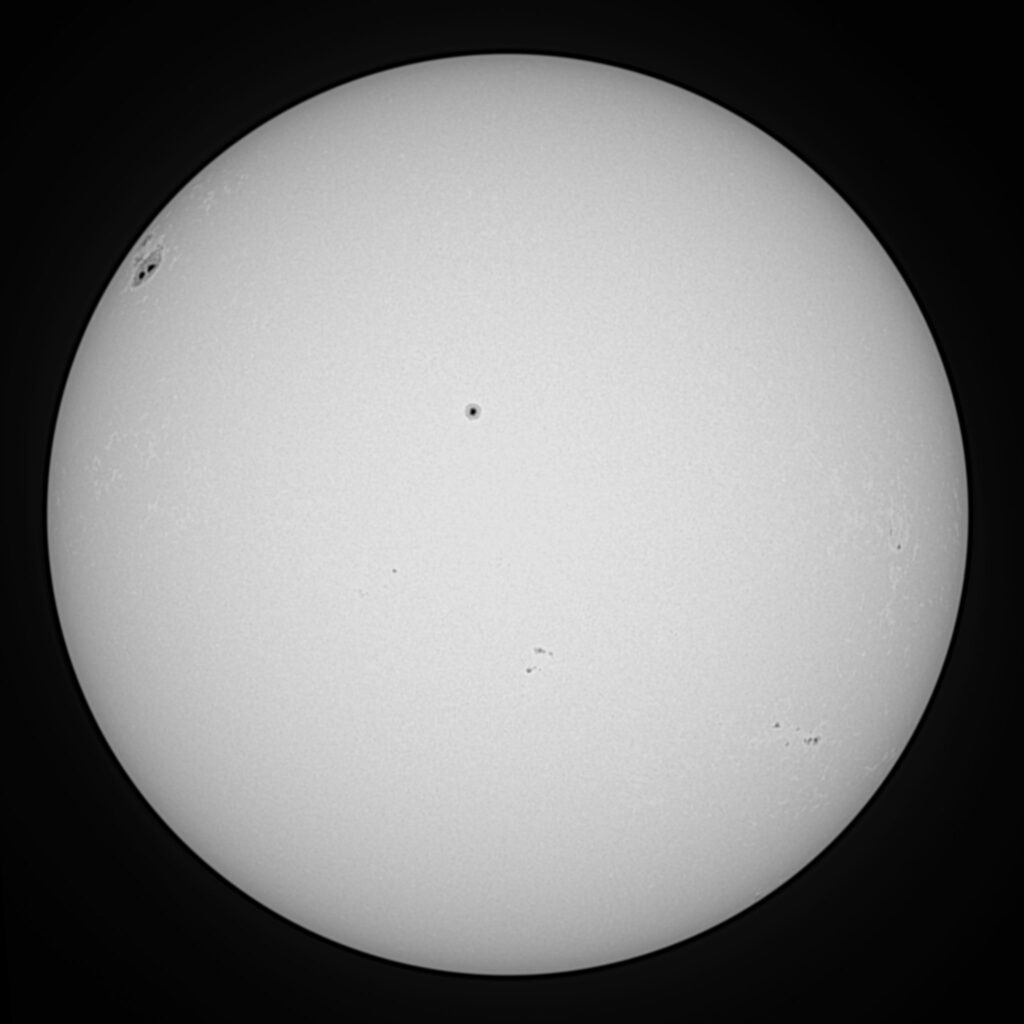
| Image Capture Issues | As bad as the observing weather was in the prior rotation, this one was worse. It has also added the complexity of smoke from wild fires in western Canada reducing transparency starting, roughly, from June 8.
The frequent cloudy weather provided great practice in "sneaking" images given the briefest opportunity, assisted by the Seestar's quick setup. When the sun's disk is visible, but behind clouds, the Seestar's auto solar acquisition will often "fail". It usually gets you pretty close, however. The disk is almost always in the direction of the brightest clouds you can see in the live video stream, so I've learned to slew the telescope towards the light. Generally speaking, the sharp focus index is in a fairly narrow range, so I've learned to pre-focus the telescope to 1630. It means I can capture a useful image on the very first clear moment, and refine it within a useful range by enlarging the video image and adjusting focus manually. This is more accurate than the autofocus unless there's at least 30s of cloud-free vision. Almost always, sharp focus is in the range 1620 to 1650, and usually on the lower end of that range. |
 May 13 [replace]