Arp’s Peculiar Galaxies
Page 12 of 18
Arp observations 111-120 of 179 total to date.
| Thumbnail | Title/link | Arp Category | Date Observed | Observer Description |
|---|---|---|---|---|
 |
Arp 213 / IC 356 | Galaxies with irregularities | 2024-02-29 00:00:41 | This is a beautiful, bright spiral galaxy, slightly elongated. Normal to the casual astronomer. Unless you read Arp's remarks: "Faint straight absorption lanes lead toward nucleus, become triple". What is an absorption lane? I believe it's a cool (darker) dust lane that obscures some of the light emanating from the galaxy, absorbing specific wavelengths and creating "absorption lines" on the galaxy's spectrum. Can I see it on the image? Yup. If you look for it, it shows up clearly in Arp's capture as a light feature. In my color image it shows up as a slightly darker-brown feature from the edge of the disk in the NW (upper left) towards the center.As it approaches the nucleus, it forks into at least two prongs (and 3 in Arp's higher resolution image). If the galaxy were an eyeball, this dust lane would make it appear slightly "bloodshot". The second image in the gallery shows two color views of the galaxy, where the color balance is shifted slightly to improve the absorption lane's visibility, and where a second image shows arrows to locate the feature explicitly. I did not take notice of this until I went looking for it, triggered by Arp's remarks. Who knew it made the galaxy peculiar? |
 |
Arp 214 / NGC 3718 | Galaxies with irregularities | 2024-04-16 21:30:00 | Arp's remarks speak volumes: "Barred spiral, sharp nucleus, narrow absorption lanes through center." When I originally captured this, I was unaware of Arp's remarks, and completely missed the key feature: the absorption lanes. I thought it was the arms. This is a striking target worth revisiting. Was enjoying watching the image build until a wall of clouds stopped the observation, hence the short capture time. That said, despite the short integration time, the lanes are strikingly evident. |
 |
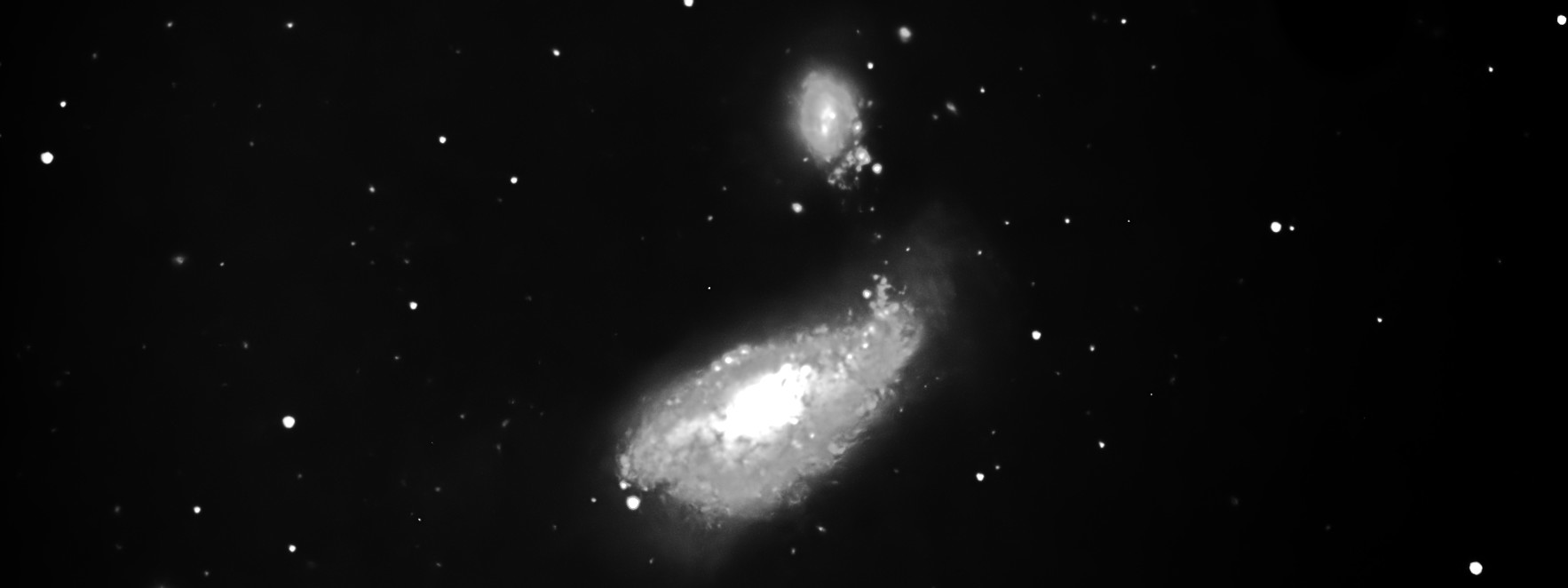
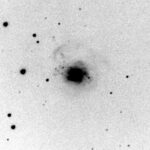
Arp 215 / NGC 2782 | Galaxies with adjacent loops | 2026-03-01 20:41:00 | Arp's "Adjacent Loops" category is problematic in my experience. He uses it to describe galaxies with extensive stellar streams or dust lanes surrounding a galaxy, with an apparent gap around the disc. But in my experience, it is applied to low surface brightness features that the 200" Hale, and its film plates, can't resolve properly. And so it is here, I think. Look, a 200" mirror gathers 625x as much light as my 8" SCT. BUT, the film emulsion in the best case is about 30x less sensitive than my CMOS camera. Worse, the emulsion is blind to red and near-IR wavelengths. That's why my capture here is roughly equivalent to Arp's in terms of depth. Bottom line, if you look at the "survey" image in the gallery, produced at the Perimeter Institute from a composite of disparate images of this target, the adjacent "loops" appear to be a dim galaxy in the process of being absorbed into NGC 2782. |
 |
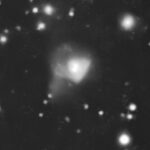
Arp 217 / Bow and Arrow Galaxy / NGC 3310 | Galaxies with adjacent loops | 2025-05-11 22:26:00 | The first observation following a clear day, but with a full moon. As it turned out clear enough. This has a very bright galactic core, and is another William Herschel discovery from 1789. |
 |
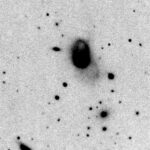
Arp 220 / NGC 5421 | Galaxies with adjacent loops | 2025-07-23 14:23:54 | Arp 220 is the closest ultraluminous infrared galaxy (ULIRG) to Earth, and heavily distorted. Arp saw a bright nucleus, then wispy arms that seemed to form a loop surrounding empty space (as do the other 5 galaxies in this category of "Adjacent Loops"). However, shockingly, even my little 8" telescope could go "deeper" than Arp's image, and shows what is an extended, lower surface brightness body behind the bright nucleus. It's certainly not the 200" telescope which has several hundred times the light gathering power of my telescope. |
 |
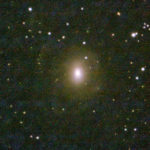
Arp 224 / NGC 3921 | Galaxies with amorphous spiral arms | 2025-05-15 23:15:00 | An unexpecgted observation: forecast was mostly cloudy but it turned beautifully clear around 9 PM and stayed that way for a couple of hours. This is another William Herschel discovery from 1789. |
 |
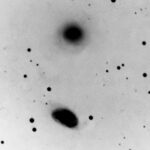
Arp 225 / NGC 2655 | Galaxies with amorphous spiral arms | 2024-02-29 00:00:45 | Amorphous spiral arms indeed! They are shaped a bit like loose outer leaves of skunk cabbage, with the nucleus as flower. During capture the amorphous arms were just perceptible on my SharpCap live stack, which means that post-processing was required to make them visible in the final web images. The core and central disk are quite evident, but the arms are diaphanous. Arp's remarks also call out an absorption, the zit-like feature on the SSW (1 o'clock) edge of the nucleus: "Very faint diffuse outer arms, absorption one side of nucleus". Interesting that it's the diffuse arms he chooses to categorize. |
 |
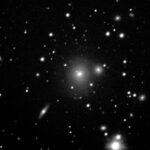
Arp 227 / NGC 470 / NGC 474 | Galaxies with concentric rings | 2025-10-10 22:52:00 | This was a target for the October '25 CN EAA Challenge. NGC 474's faint but massive rings are quite a sight! Arp's recorded in his notes: " Pos. of spiral.SO is E and a little N.Very faint rings extend to diameter of 7'.4." |
 |
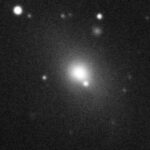
Arp 229 / NGC 507-508 | Galaxies with concentric rings | 2024-12-26 19:39:00 | NGC 507 is a large and relatively bright galaxy where the galactic disc forms discrete rings of diminishing brightness as you move away from the core. Arp remarks: "Circular or near circular rings of small density difference." This is categorized as a lenticular galaxy: more structure than a typical elliptical galaxy, but lacking the arm structure for a spiral. If you examine all of the galaxies so categorized in the Atlas (227-231), the first three (227-229) all depict a pair of galaxies, with a large, central lenticular galaxy. Confusingly, the other two (230-31) depict polar ring structures within a single, lenticular framework. |
 |
Arp 232 / NGC 2911 | Galaxies with concentric rings | 2025-01-26 22:18:00 | There's a conundrum here. Kanipe and Webb's book reports that Arp places this in the "appearance of fission" category. The database I created for my website which automatically looks up the Arp Category based on the Arp number (based on the AL's Arp excel list) puts this in the "concentric ring" category. The Cal Tech website providing an online version of the Atlas of Peculiar Galaxies omits Arp 232 from Figure 2 (see gallery) which is the only place where you can look up Arp's categories. For no apparent reason it skips from Arp 231 to 233. To my eye, concentric rings seems more descriptive of what I see, and is similar to Arp 229's appearance. Moreover, most of the "with fission" galaxies, starting with Arp 233, show a very distorted galactic center, usually more heavily pinched if not fully broken apart. 232's center shows a slight pinch from the SE (lower left) not nearly as dramatic as other "with fission" galaxies. Arp does call out an "Absorption lane reaching away from galaxy" which is responsible for that pinched look, and may account for Kanipe and Webb's decision. However, Arp put other galaxies with absorption lanes into "Galaxies with irregularities" so I don't think Kanipe and Webb's decision to place it into "with fission" is correct. |