Arp’s Peculiar Galaxies
Page 15 of 18
Arp observations 141-150 of 179 total to date.
| Thumbnail | Title/link | Arp Category | Date Observed | Observer Description |
|---|---|---|---|---|
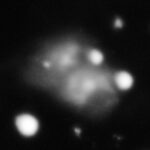 |
Arp 275 / NGC 2881 | Interacting galaxies | 2026-03-10 21:55:00 | Arp left no observing remarks for Arp 275, so his only commentary is the category. "Interacting galaxies" is non-committal. Most modern commentators suggest this is two spiral galaxies "colliding". Seems plausible, though Arp abhorred the idea, deriding it as "merger mania". He preferred "fission" or ejection, though neither seems as plausible as "collision". I've added the Hubble image of the pair where you can see a well developed spiral structure on both ends, presumably formed in a circle, and now being squared off in the collission like two Parker dinner rolls. |
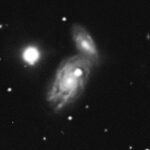 |
Arp 276 / NGC 935 and IC 1801 | Spiral galaxies with elliptical companions on arms | 2025-11-22 19:34:00 | This target was captured on a dark night, with only so-so seeing. This is a classic Arp object, relatively large and bright by comparison to many. Arp's comment is simply: "Both intersecting edges seem dimmed. " which is true enough but leaves me wondering why it matters. This seems another example where Arp's fetish against galaxy merger seems misplaced. Because the smaller galaxy attaches at the top of the spiral and not at the end of the big arms, Arp can't call it a "companion". |
 |
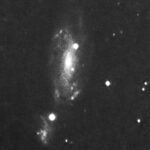
Arp 278 / NGC 7253A-B | Interacting galaxies | 2023-10-23 00:00:00 | This was my first direct experience with capturing an "Arp Peculiar Galaxy" while participating in the Cloudy Nights EAA Forum October 2023 Challenge. I struggled mightily to find it, since I had not extended SharpCap's library to include the Arps, and the coordinates I found online were J2022, not the J2000 that SharpCap requires. Once I found the target, it was a straight forward capture, which I enjoyed immensely. It certainly shows two galaxies interacting. Most would say "merging" but I didn't appreciate the depths of that controversy at the time. Anyway, I fully enjoyed this observation and it predisposed me to take on the AL challenge when I learned about it a few months later. |
 |
Arp 279 / NGC 1253 | Interacting galaxies | 2025-01-24 20:54:00 | This is really a remarkable testimony to how sensitive the Apollo M-Mini camera really is. Under 5 minutes and it shows everything necessary. Not the "beautiful" capture I would have liked. But clouds rolled in. The two galaxies are obviously interacting... you can see the little nub on the large galaxy towards the small one as well as the extended spiral arm on the opposite side. The only thing you can't see in this capture is the dust halo around both galaxies, particularly the smaller one. But I'm not sure it adds much to the story in this case. |
 |
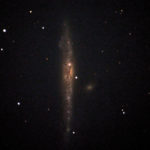
Arp 280 / NGC 3769 | Interacting galaxies | 2024-04-21 23:53:00 | NGC 3769 is an elongated, barred spiral galaxy of magnitude 11.7, while NGC 3769a, located in the right of the image, and slightly obscured, is magnitude 14.7. Below (north) of NGC 3769 is a small smudge described as a 'knot' in the Arp atlas, which could be a dwarf galaxy. they are clearly "interacting". Most astronomers would, today, say "merging". |
 |
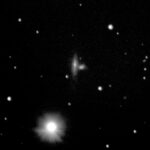
Arp 281 / Whale Galaxy / C32 | Galaxies with infall and attraction | 2024-02-19 00:00:55 | Another William Herschel capture from 1787, this galaxy is a large, relatively bright target which is fun to capture. It is also a "peculiar galaxy". Arp categorizes this as a galaxy "with infall and attraction", where the most obvious sign is the small galaxy NGC 4627. This appears to the right of the whale, just below center. The "Whale" appears to be an unusually thick spiral galaxy viewed edge-on, with no obvious, additional bulge in the center. There is a small bump towards the top left of the galaxy (the whale's "head") which may be evidence of a prior infall. The Oxford online dictionary defines "infall" this way: "the falling of small objects or other matter on to or into a larger body". This is as close as Arp gets to the concept of "merger", though infall implicitly excludes the notion of peer galaxies coming together. Arp notes, "Diffuse counter tail on companion [NGC 4627]". It's not clearly visible on the color images, but shows up (semi-distinctly) on the inverted rendering (and, of course, is very clear in Arp's). |
 |
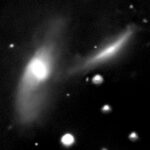
Arp 282 / NGC 169-169A | Galaxies with infall and attraction | 2024-12-12 21:42:00 | Considering this was captured on a 93% moonlit night, it's pretty amazing, and testament to the power of the Apollo M-mini mono camera. All of the key details, particularly the dust trail to the lower right on IC 1559 (the dwarf galaxy), are visible, which I interpret as stars left behind while the bulk of the dwarf galaxy is drawn into a merger with NGC 169. It's even more clear in an inverted rendering of my image. As usual I prepared a direct comparison with the plate published in Arp's Atlas of Peculiar Galaxy, which shows the ultimate image using 1960s technology. I couldn't resist adding a Hubble Space Telescope image I found on Wikimedia Commons, licensed under a Creative Commons 2.0 license (and anyway, as based on Hubble data, inherently public domain). This shows how much technology improved in roughly 40 years. Of course the idea that I could capture an inferior, albeit adequate, image in half an hour from my back yard is mind blowing. I would have extended the capture, but high clouds were starting to trigger brightness filtering so I shut this capture and moved to another part of the sky. |
 |
Arp 283 / NGC 2798 / NGC 2799 | Galaxies with infall and attraction | 2026-03-01 20:48:00 | There are only 6 peculiar galaxies categorized with "infall and attraction" which is as close as Arp comes to describing what in modern parlance we could call a galaxy merger. Arp believed galaxies were much more likely to "eject" a companion galaxy than attract a merger. He called the desire for users of his atlas to attribute many of the phenomena to mergers as "Merger Mania". Here, particularly given the slightly "deeper" image I could pull off, a merger in progress seems very likely. |
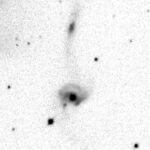 |
Arp 284 / NGC 7714 / NGC 7715 | Galaxies with infall and attraction | 2023-10-10 22:30:32 | There are two obvious galaxies in the frame: NGC 7714 is a distorted, more or less round, spiral galaxy in the center of the image that appears to be attracting stellar material from above and below. Below, the new material deformed a large spiral arm, out- and downwards. 7714 has a very bright galactic nucleus and the rest of the spiral disk is bright and well formed. NGC 7715 is much less bright, with a dim center. We appear to be viewing it edge-on, distorted into an integral sign shape that runs right to the edge (and behind?) 7714. The fact that 7714 is brighter and more intact suggests it is the dominant galaxy of the two. I'm wondering if the bright spot just below 7714 is a dwarf companion also in the process of "infall". Arp doesn't mention it in his notes, so may not be likely. Still it does have a suspiciously companion-like structure. |
 |
Arp 285 / NGC 2854 / NGC 2856 | Galaxies with infall and attraction | 2024-02-05 00:23:30 | Captured in a combined image with Arp 1. These two emerged first, substantially brighter than Arp 1. The foreground galaxy, NGC 2854, is a spiral, barred galaxy forming an extended "S" curve pointing directly to NGC 2866 with a hint of a dust lane connecting them (seen more clearly in the Arp plate); NGC 2856 is a more regular, compact spiral. A jet visible in the Arp plate shoots in the general direction of Arp 1, explaining Arp's description that a "Narrow tail leads away from northern nucleus." The "jet" is not visible in my capture neither in color nor inverted grayscale. |