Arp’s Peculiar Galaxies
Page 16 of 18
Arp observations 151-160 of 177 total to date.
| Thumbnail | Title/link | Arp Category | Date Observed | Observer Description |
|---|---|---|---|---|
 |
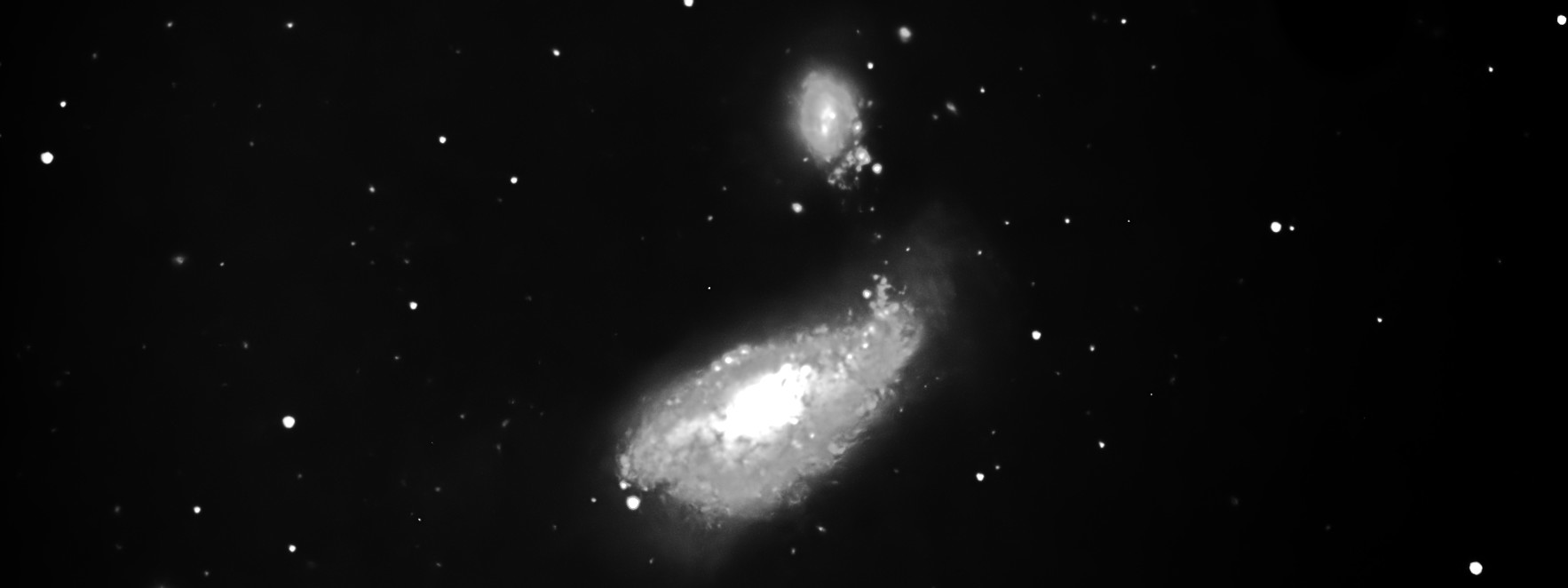
Arp 288 – NGC 5221 and 5222 | Galaxies with the appearance of wind effects | 2025-07-21 22:14:00 | I believe this is the first Arp object I've observed which is categorized with the "appearance of wind effects". It's an evocative description, and certainly appropriate. As Arp remarks in his recorded notes: "Streamers in both directions from edge of spiral," presumably describing the appearance of NGC 5221. The big mystery is what caused this level of tidal tails... certainly NGC 5222 doesn't seem up to it by itself. Possibly it's responsible for the relatively short lip that points downwards. But the long tail? That requires some serious motion and mass. |
 |
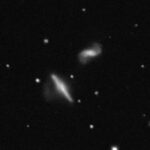
Arp 290 / IC 195 and 196 | Galaxies with the appearance of wind effects | 2025-11-22 21:29:00 | This is a very peculiar galaxy. Wind effects? Yes, it does appear that way, especially in the inverted images, and especially in Arp's. It looks like a galaxy weeping stars. The result of an interaction with the smaller galaxy, or something else. A mystery. |
 |
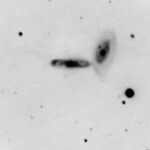
Arp 293 / NGC 6285-6286 | Galaxies with the appearance of wind effects | 2025-06-29 23:33:00 | A straightforward observation on a good observing night. 12m is relatively short integration, but I could see in SharpCap that the tidal "fields" that evidence interaction were quite visible, and the overall size of the target wasn't going to support much more structure or detail. |
 |
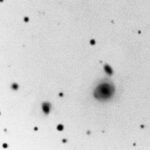
Arp 294 / NGC 3786 / NGC 3788 | Double or multiple galaxies with long filaments | 2026-02-27 23:58:00 | Arp's remarks say, with typical economy, "Peculiar filaments". That presumably refers to the stellar stream heading NNW (left) from NGC 3788. Subsequent to my capture, I've found long exposure astrophotographs showing a circular stellar stream looping behind the south side of NGC 3786. That's barely hinted at in Arp's image, and mine. . |
 |
Arp 297 / NGC 5754 – 5752 | Double or multiple galaxies with long filaments | 2025-06-12 00:39:00 | Captured on a full moon night with even a little smoke, which improved the later it got. I believe it's important to capture the feature Arp cared the most about, and in this case its the tidal filament extending from the bottom of NGC 5754 and looping up and to the right connecting it to NGC 5752. The additional filaments out of NGC 5755 probably increased the peculiarity. While conditions were far from ideal, the image was building slowly and I could just start to see the filaments at about 50 minutes. In the conditons, I'm pleased I can see it at all. |
 |
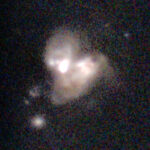
Arp 298 / NGC 7469 with IC 5283 | Unclassified double galaxies | 2024-10-28 22:26:00 | This is one of the more unusual Arp Catalog entires: two galaxies in close proximity. The only suggestion that they are interacting is a slight twisting of an arm in the small galaxy (IC 5283) towards NGC 7469, an elongated core, and a slight suggestion of a dust trail. NGC 7469 appears to my eyes as being type S0 - aka Lenticular -- intermediate between a spiral and elliptical. There remain clear spiral structure in the core, which is fading in the outer envelope.. |
 |
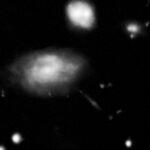
Arp 299 / NGC 3690 / IC 694 | Unclassified double galaxies | 2024-05-24 23:07:00 | Another surprisingly good capture given a waning moon just a couple of days past full. Luckily aiming directly away. These galaxies are astonishing. Two appear so well integrated that they have a single NGC number instead of two consecutive, or, as you see often an A/B. They both seemed to be irregular barred galaxies that, by this point, have merged galactic centers. Even Arp seems resigned to the fact in his remarks: "Bright internal knots." The dwarf IC 694 seems to be sucked in from the bottom of the image as well. |
 |
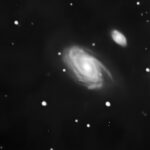
Arp 300 / UGC 05028 / UGC 05029 | Unclassified double galaxies | 2026-03-27 23:55:00 | Arp 300 consists of two interacting galaxies, UGC 05028 (the smaller face-on spiral galaxy) and UGC 05029 (the larger face-on spiral). UGC refers to the Uppsala General Catalog of Galaxies, about 12,000 targets identified in the Palomar Sky Survey completed in 1958. Both of these objects were too faint to be included in NGC or IC which were identified prior to WWI, and as early as the 18th century, optically, in the case of NGC. |
 |
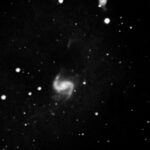
Arp 304 / NGC 1241 and 1242 | Unclassified double galaxies | 2025-11-22 22:28:00 | Arp 304 consists of two galaxies NGC 1241 and NGC 1242, left to right and a double star to the southeast, NGC 1243. The two galaxies were first seen by William Herschel. John Herschel, unable to see 1242 recorded the double star NGC 1243. Dreyer saw all three but recorded the double star as a nebula. Arp didn't seem too fussed as he left no remarks. The only peculiar structure seems to be a slightly enlarged arm on NGC 1241 pulled away in the direction of NGC 1242. |
 |
Arp 305 / NGC 4016 / NGC 4017 | Unclassified double galaxies | 2026-03-27 23:00:00 | Arp's comment on this pair of galaxies suggests he was intrigued, "Segment breaking from arm of S gal., weak filaments reach to N gal., which has figure 8 loops." My initial reaction was that we were looking at tidal debris, the legacy of a fly-by, though I was puzzled by the linear splotch, the most visible part of an incomplete debris trail connecting them, slightly closer to NGC 4017. Turns out Arp 305 has been studied recently, and that "splotch" is a cluster of Compact Dwarf Galaxies, created in the debris from the fly-by, representing areas of significant star formation. I provide links to the papers at the bottom of the page, below the gallery. |