Arp’s Peculiar Galaxies
Page 7 of 18
Arp observations 61-70 of 179 total to date.
| Thumbnail | Title/link | Arp Category | Date Observed | Observer Description |
|---|---|---|---|---|
 |
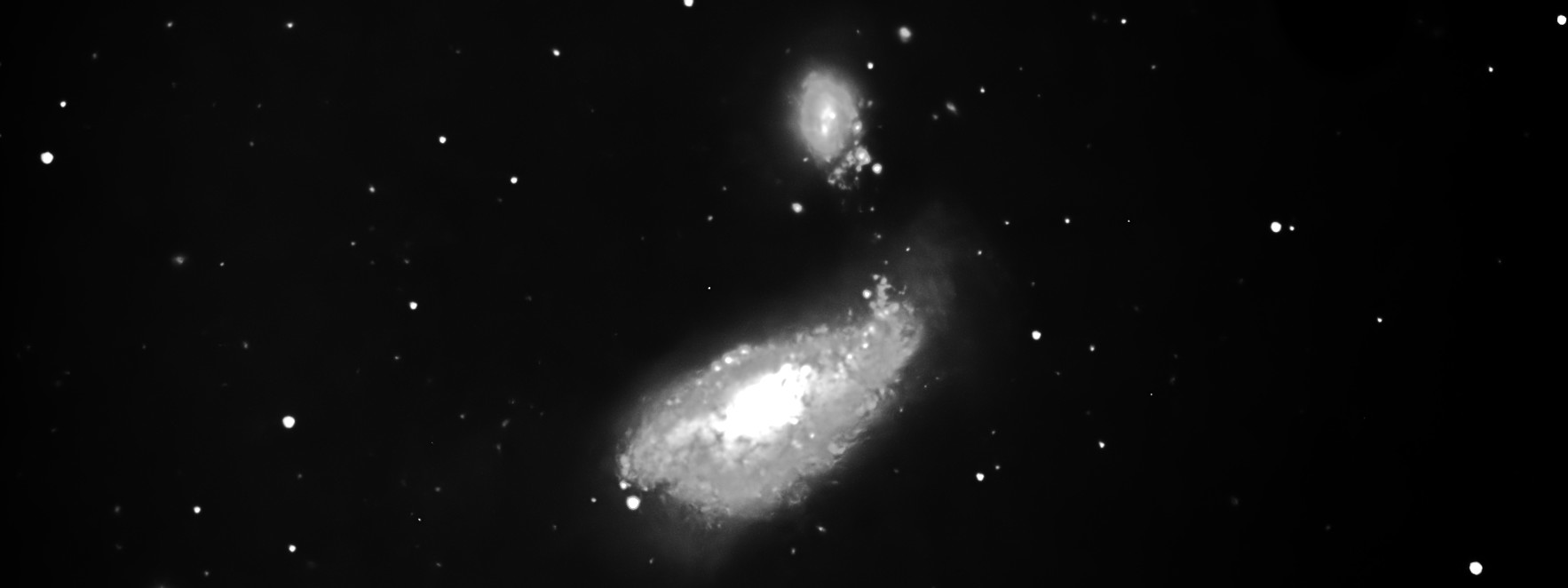
Arp 117 / IC 982-983 | Elliptical galaxies close to and perturbing spiral galaxies | 2024-06-01 00:12:00 | A fascinating pairing of a large, low-surface brightness, barred spiral galaxy (IC 983) interacting with (absorbing?) a smaller elliptical galaxy (IC 982) (upper left). Essentially the spiral arms of 983 are directly connected to 982, which can best be seen in the grayscale, inverted version of my capture, found second in the gallery. Also, note the large, upper right circle is a Milky Way star, easily ingerpreted as a double star in my color images. It's significant that a galaxy as large as 983 wasn't discovered in time to be published in the NGC catalog, no doubt because the low surface brightness galaxy could only be seen in photographic plates. All NGC objects were discovered visually. The IC catalog was an extension of NGC published in 1888 and 1905. IC objects were discovered both visually and with photo-plates. Anything discovered later was almost certainly discovered using photography. |
 |
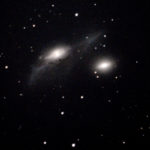
Arp 119 / UGC 849 / Mrk 984 | Elliptical galaxies close to and perturbing spiral galaxies | 2025-09-21 23:02:00 | Arp saw an Elliptical Galaxy perturbing a nearby Spiral. His notes say, cryptically, "Some material seems attracted, some repelled," which is a prescient comment, given more modern research. |
 |
Arp 120 / Eyes Galaxies | Elliptical galaxies close to and perturbing spiral galaxies | 2024-03-13 12:11:14 | What a fun target! The two galaxy centers are bright and were evident from the first 30 second frame. So the two galaxies "close to each other" is obvious, but it takes a while for the "perterbation" to become obvious, and best viewed in the inverted image. The extensive dust clouds connecting these galaxies are much lower brightness and took a while to become evident. Luckily it was a clear, dark night and I was able to continue integration until I judged minimal additional detail was forthcoming, after about half an hour. Very peculiar! |
 |
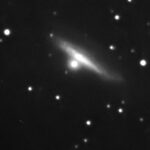
Arp 122 / NGC 6040 | Elliptical galaxies connected to spiral galaxies | 2025-07-02 23:55:00 | Two more Arps in the Hercules cluster, these two spiral galaxies distorting each other as they merge. |
 |
Arp 123 / NGC 1888 and 1889 | Elliptical galaxies close to and perturbing spiral galaxies | 2025-01-23 21:13:00 | Arp classifies this object as an elliptical galaxy close to and "perturbing" a spiral galaxy. Because the spiral is seen edge-on and my 8" Celestron doesn't match the optics of the 200" Hale telescope, the "perturbing part" is hard to figure out. I decided to analyze my image inverted. Sure enough, the up-flip of the lower right spiral edge and the dust halo on the opposite side are a quite a bit clearer than in the positive. [Note: this was the first observation where I created an inverted image. I've subsequently gone on to create them for many more, including observations I'd previously written up.] Researching this after the fact, the the dust on the opposite side is thought to be a crop of young stars stimulated by the absorption of the elliptical galaxy. There does appear to be a third, tiny distorted galaxy in the image, the closest bright object above and to the right of the spiral disk. If in the same area, it's likely a dwarf galaxy with a small tail, similar to Minkowski's Object. The tail is visible in my capture, especially inverted, but much more distinct in Arp's, given the much higher resolution of the Hale telescope. Interestingly, the spiral was discovered by (who else?) William Herschel in 1785. The elliptical galaxy, NGC 1889, wasn't discovered until 1851 by Bindon Stoney using Lord Rosse's 72" telescope. Just a remarkable commentary on the power of modern telescopes and, in particular, EAA observing techniques and CMOS cameras that I can easily resolve them from my back yard. |
 |
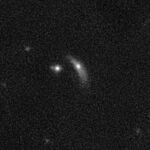
Arp 124 / NGC 6361 | Elliptical galaxies close to and perturbing spiral galaxies | 2024-06-13 23:45:00 | NGC 6361 is a straightforward target, but the tiny galaxy on its tail, MCG +10-25-3 is magnitude 15.8 and another story altogether. And, of course, the connecting dust lanes -- if they exist -- are even more obscure. Unfortunately, the evening's transparency, never very good, took a big hit after 20 minutes of integration, with a now thickened layer of high clouds shutting me down. It was tough to distinguish any connecting lane from general noise in the SharpCap capture... I processed the color image heavily in Affinity Photo and just managed to bring something out that suggest a dust lane. This is also one of the images where I also converted my image to grayscale and inverted it. At best, the "dust lane" is ever so slightly heavier than the background noise level, though you can see heavier noise levels "connecting" field stars, and between the tail of the spiral galaxy and a double star just slightly below and to the right, which are clearly just image artifacts. Arp's remarks are silent on 124. The Palomar plate doesn't really indicate a dust lane either and I toyed with it in Affinity, both changing levels and inverting it to positive with no effect. So the best evidence of perturbation is the slight extension of the arm of the galaxy in the direction of the Elliptical galaxy. |
 |
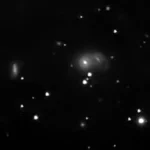
Arp 125 / UGC 10491 | Elliptical galaxies close to and perturbing spiral galaxies | 2025-06-12 00:32:00 | A full moon night with moderate smoke haze. I was amazed my capture was this good, which isn't very. An enigmatic target for sure. Even in the Arp plate, it's hard to be sure that the large galaxy is "spiral" or that the small galaxy is ellipitcal. That said, "perturbing" is evident in the curve of the right hand galaxy, based on the tidal flow between them which you can just make out even in my capture. |
 |
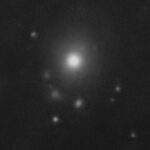
Arp 130 / IC 5378 | Elliptical galaxies close to and perturbing spiral galaxies | 2024-11-03 20:23:00 | Based on Arp's category description, it's clear that Arp felt IC 5738 consists of two galaxies: an elliptical galaxy (left/lower) perturbing a spiral galaxy (right/upper). It seems likely that when initially observed as an entry in the IC, the spiral component of the pair was not resolved. Otherwise you might expect this object to have two IC entries. Even with the benefit of CMOS cameras and stacking, distinguishing the elliptical and spiral component is challenging. Note, I felt it easier to compare my image to Arp's by inverting the Palomar plate to a positive image. On my image, there are clearly two bulges consistent with two galaxies. While spiral arm-structure is not evident, the bright galactic core provides distinctive visual evidence of a barred spiral. Arp's image, printed, benefits from the resolution supported by a 200" aperture does definitively show spiral arm structure as well as a barred center. Of course, it seems highly likely that we're observing a merger in mid-process, though Arp never uses that word and remarks are silent on this observation. |
 |
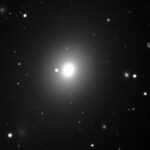
Arp 133 / Minkowskis Object / Abell 194 | Galaxies with nearby fragments | 2025-01-23 19:22:00 | This was a challenging target which I selected to celebrate the prospect of capturing my 100th Arp observation. "Minkowski's Object", discovered in 1958, is the distorted companion dwarf galaxy at the 7 o'clock position in the halo of NGC 541, the bright, lenticular galaxy in the center. Note that the featured image is heavily cropped and enlarged nearly 4x from the original. The full capture is a substantial portion of a major galaxy cluster: Abell 194. It includes Arp 308, NW of Arp 133 (E is up), consisting of two interacting galaxies (L to R): NGC 545, a lenticular galaxy, and NGC 547, an elliptical galaxy. During capture I noticed an extended halo from NGC 545 towards Arp 133, which became more pronounced after processing. Arp's remarks suggest he was very much aware of the connection, "Central member of galaxy group associated with 3C40", where 3C40 is a radio galaxy in Abell 194. More recent research on Minkowski's Object suggests it is a young, active star forming region stimulated by a jet from a supermassive black hole in the center of NGC 541. I found the included image on the Internet while researching "3C40" which shows a composite, broad-band visual image from the Lick 120" telescope overlaid with narrow-band optical and radio data from additional telescopes (https://www.nrao.edu/archives/items/show/33560). The dark blue cloud surrounding Minkowski's Object is hydrogen gas, and the obvious jet, were both detected in radio bands by the VLA radio telescope. |
 |
M49 / Arp 134 / NGC 4472 | Galaxies with nearby fragments | 2025-03-26 22:31:00 | This was the fourth and final addition, and another original discovery (#21), on February 19, 1771. It was also Messier's first elliptical galaxy in the catalog, though undoubtedly it would have appeared to him as a dim GC: "Nebula discovered near the star Rho Virginis. One cannot see it without difficulty with an ordinary telescope of 3.5-feet [FL]. The Comet of 1779 was compared by M. Messier with this nebula on April 22 and 23: The comet and the nebula had the same light. M. Messier has reported this nebula on the chart of the route of the comet, which appeared in the volume of the Academy of the same year 1779. Reviewed on April 10, 1781." <--> This galaxy was selected by Halton Arp for his atlas due to the "fragments" identified as the peculiar feature. The main fragment is visible on the 8 o'clock position just inside the lower left corner in the featured or comparison images. It's in the 4 o'clock position in the un-cropped captures, and particularly evident in my inverted image. It's clear an enormous amount of tidal flow exists between M49 and whatever this "fragment" is, presumably a distorted dwarf galaxy. Other fragments may also be visible, particularly in my inverted image, mostly on the opposite side of M49 within its outer halo. Also, find my original Seestar 11m capture in the gallery, as well as the annotation to its wider FOV. It does not have the resolution to show the Arp data but provides a nice view of M49 in context. |