Observing Moon in Conjunction with M45
A rare opportunity to image both the moon and the Pleiades in the same FOV.
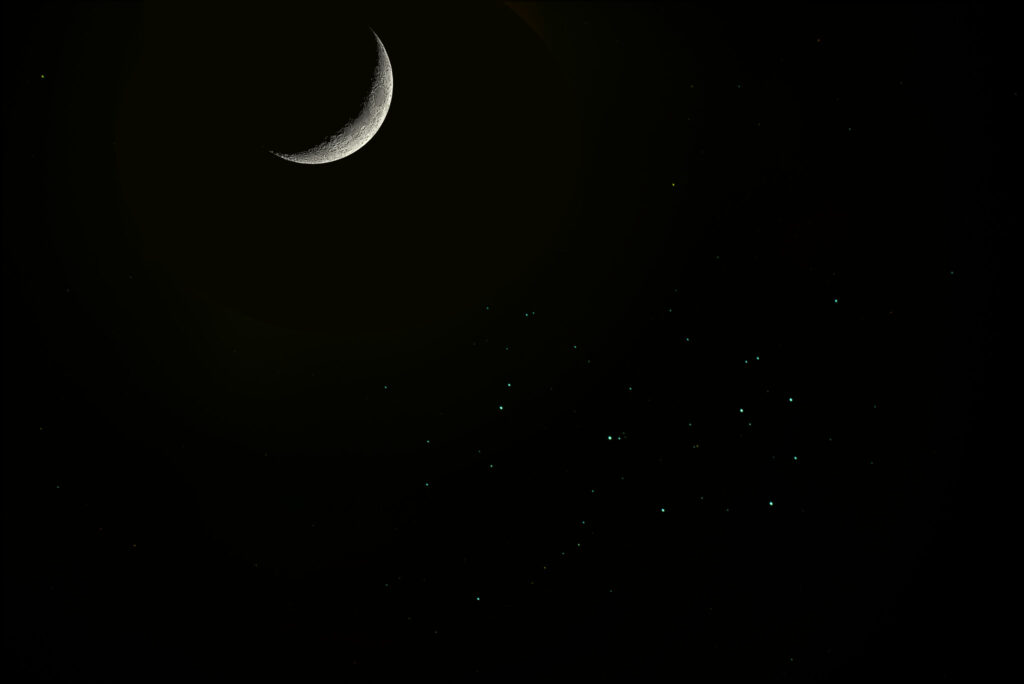
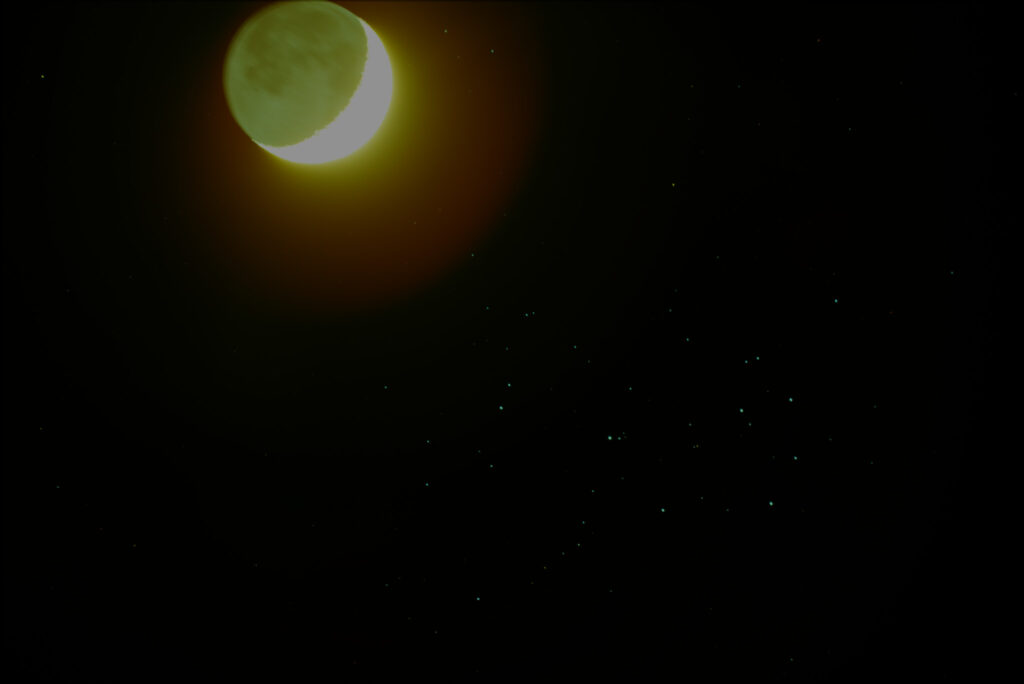
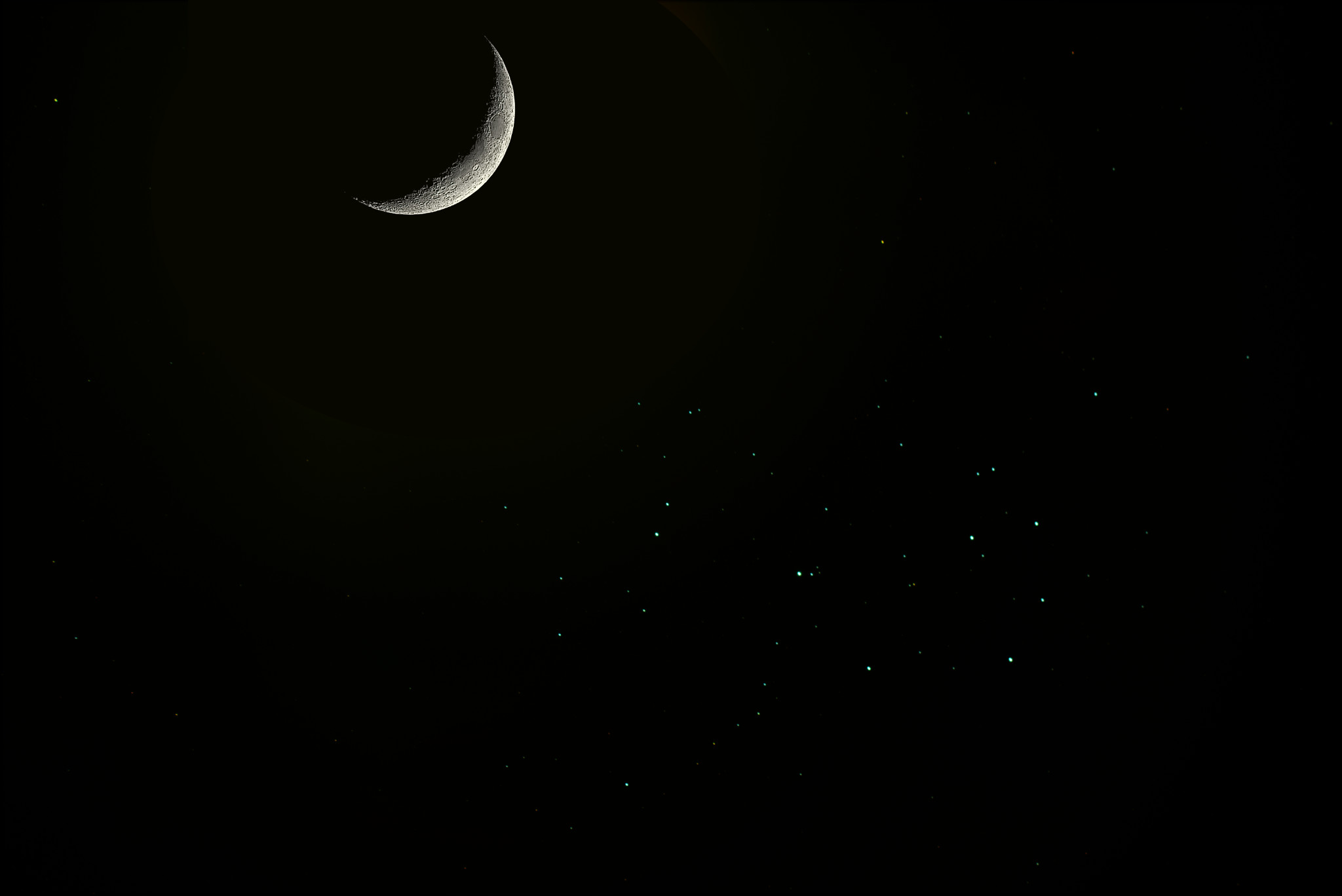
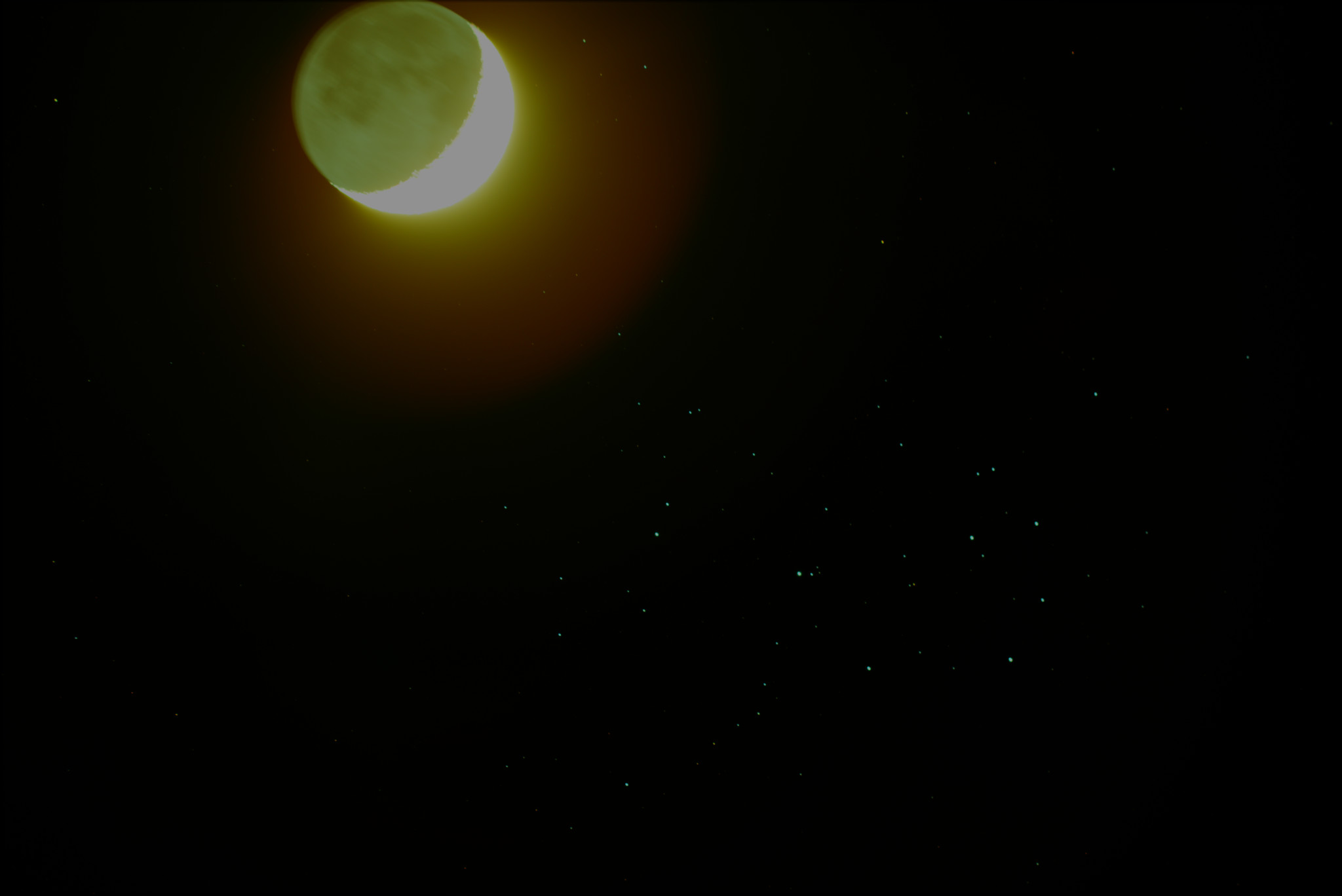
On the first clear night after we decided to pursue the Lunar Observation (Imaging) award, we noticed that the 4-day moon was in conjunction with the Pleiades (M45). This seemed like a golden opportunity to fulfill the “Optional” Telescope Object to “Plot the moon’s hourly motion against the stars for two hours or more.”
Since we were imaging, we still needed to polar align and wait for it to get reasonably dark in order to image M45. The conjunction was taking place with both objects close to setting.
We managed our first observation at 8:52, and our last at 10:30, a total of 1.63 hours. We would have gladly continued the observations except that the Pleiades had fallen below my western horizon.
The explanatory text is keyed to the images that follow.
We’ll note the first image in the gallery above is a composite of the 8:52 capture. We used SharpCap’s real-time lucky imaging, designed for the moon and planets, to capture the moon immediately after the initial M45 live- stacking capture (designed for DSOs). We then used Affinity Photo to replace the “blown out” moon in the “DSO stack”. To compare the composite to the original, you can toggle the images in the above gallery. Since the same telescope was in use, dropping in the moon was simple: it was precisely the right size. The only hard part was to eliminate the moon halo in the original image while keeping the sky looking natural.
Capturing the Images
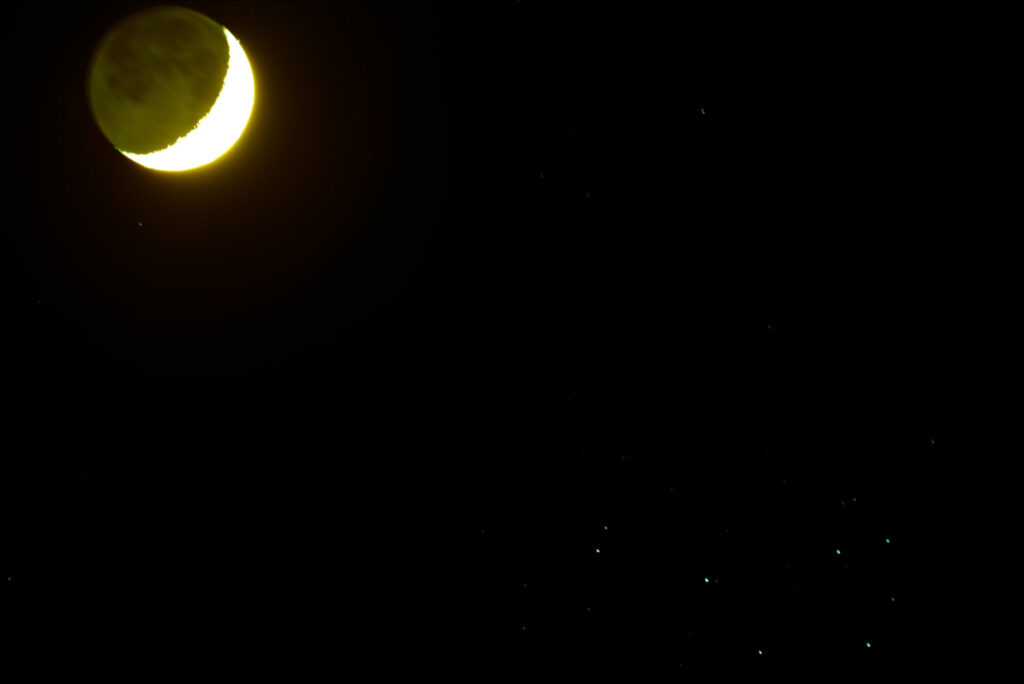
The biggest problem in capturing M45 was the huge brightness differential between the stars and the moon. Originally I’d hope to capture M45 with nebulosity, but that proved impossible. The exposure required for that, say 15s and 210g, resulted in a moon halo so large it completely washed out M45. So I ended up cutting the DSO stacking to 1s / 0g. This resulted in stars that were essentially points of light, but at least SharpCap’s DSO stacking could track them and align the frames. Given the large frame size of the 2600, the effective frame rate was roughly 5/minute despite the short exposure. The above image is the 22:30 image.
In order to keep both the moon and M45 completely in the frame as their separation grew, I used SharpCap’s click and recenter tool. Note the separation has increased significantly, but both (barely) fit within the frame.
Because I realized there was no hope of capturing nebulosity, I maintained the final exposure for only 6s (6x1s) instead of the 21s in the original image. That was sufficient to show the naked eye Pleiades stars while minimizing moon blow out. I was also worried about the oncoming horizon and wanted to save an image as quickly as possible.
That concern was well-founded as the next image failed to stack.
Calibrating the Measurements
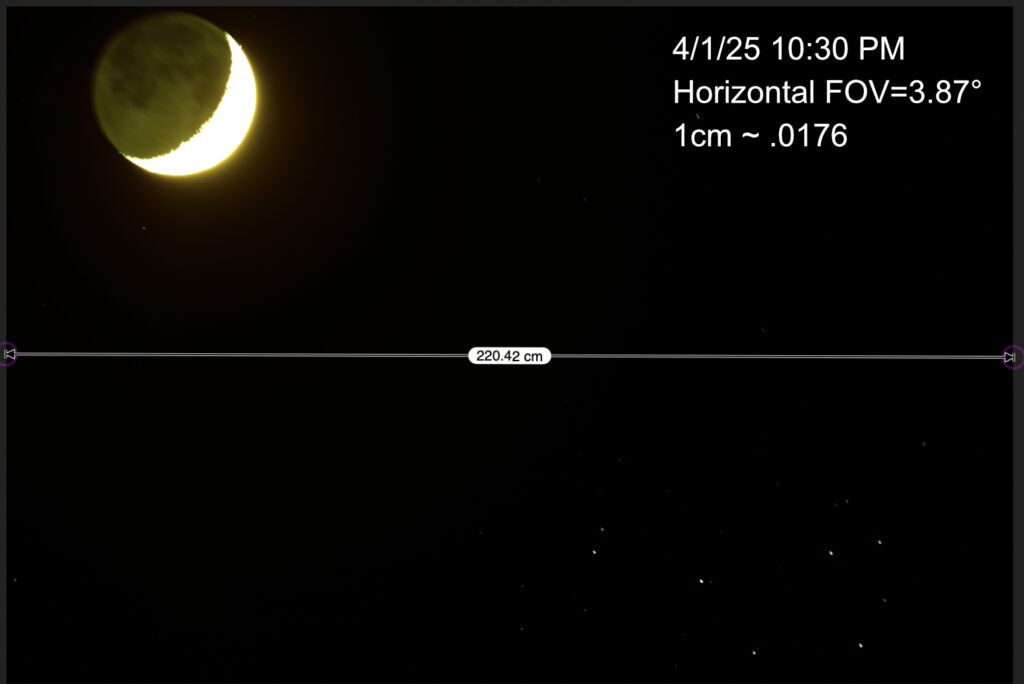
Affinity Photo includes a handy measure tool. The key issue was to calibrate it.
Measurements are in your units of choice: I chose centimeters. This is based on a dpi setting for the image, but I realized it would be simple to translate directly from “centimeters” to degrees.
I knew from having entered all of the particulars of this imaging setup in Sky Safari that the full FOV of this telescope and camera was 3.87°. The full image measured 220.42 cm. This translated to 1 cm = 0.0176°.
Measuring the Separation
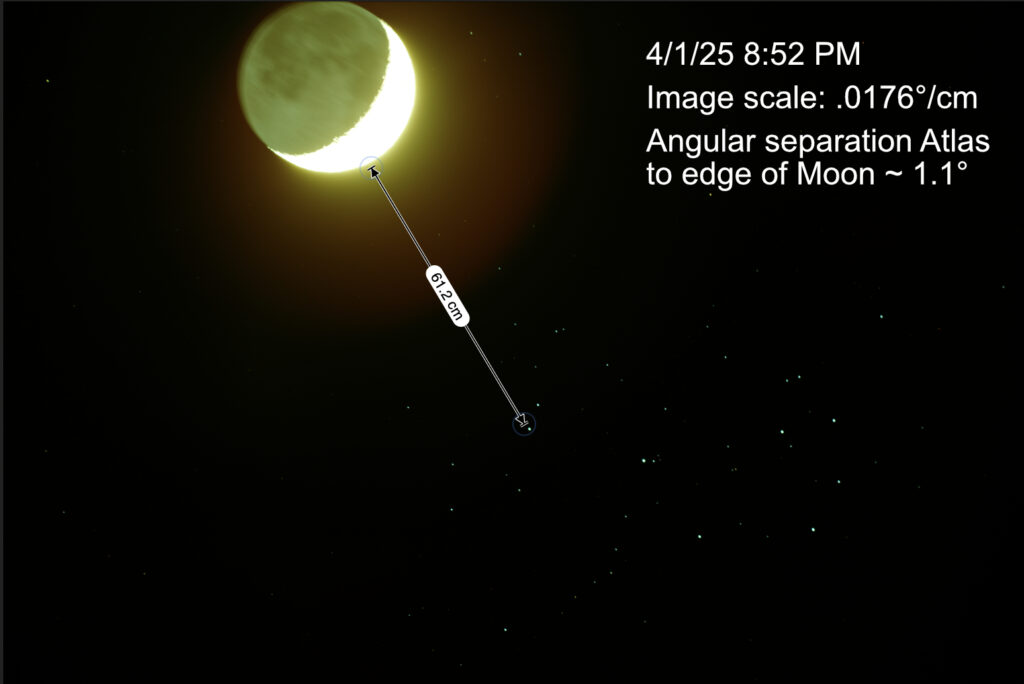
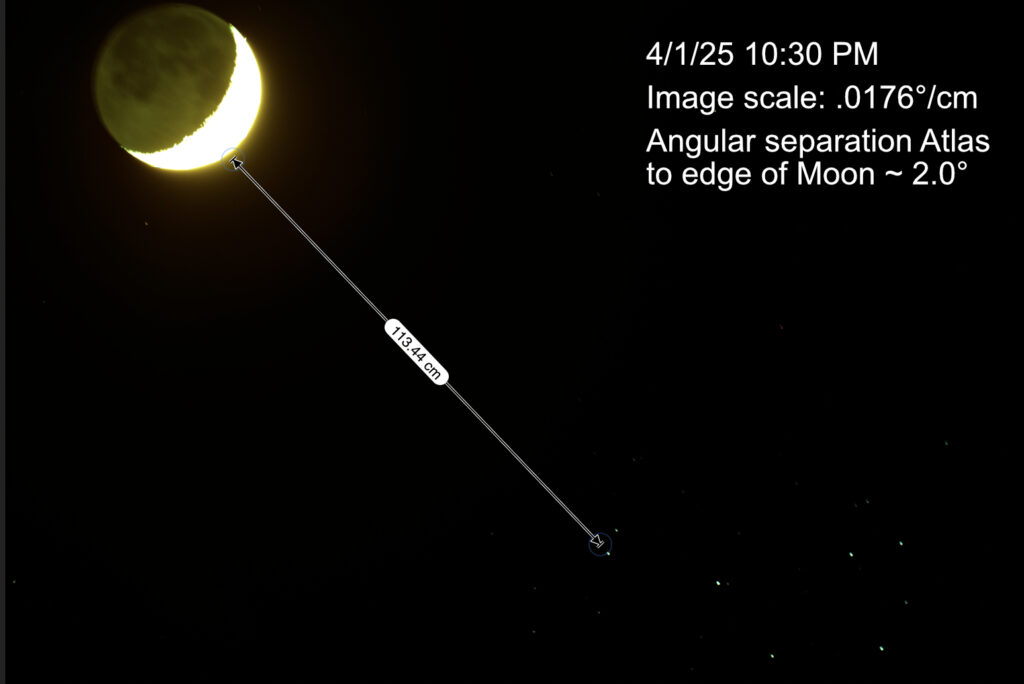
Altogether, the two measurements differed by 0.92°. Total elapsed time was 1.63 hours. This results in a slower rate of movement for the moon of 0.56° per hour.
This is similar to the “internet answer” of “half a degree per hour” and is probably within our margin of error anyway.
That said, the error measurement conflates two sources of error:
First, the movement of the moon eastward as part of its roughly 29.5 day cycle. Second, a difference in declination (more or less N or S) due to a roughly 10% tilt of the moon’s orbit around the earth relative to the earth’s axis of rotation. This averages roughly 1.8 arc minutes per hour (0.03 degrees) and could well explain the difference, especially since it is not uniform throughout the cycle.
Observer Comments
| Image Capture Description | Most of the pertinent description of the image-capture is in the main text above. Of course, SharpCap's DSO stacking is not designed to track the moon. I did find it amusing that that all of the maria are visible in the stacked image, particularly the longer first one, despite it being a 4 day moon. The details to the right refer to DSO stacking details. Details of the 4-day moon capture using SharpCap's lucky imaging and wavelet processing (which isn't actually part of this task) can be found in any of the 4-day reports elsewhere in this submission. |
| Program Links | <Previous | Lunar Program Listings | Next> |
| Date and Time Observed | 2025-04-01 22:00:00 |
| Phase Age | 3.8 days |
| Lunar Phase | Waxing Crescent |
| Illumination | 17% |
| Conditions | Transparency: Good. Seeing: Good. |
| Obs. Lat/Long | 42° 17', 073° 57' |
| Capture Software | SharpCap |
| Capture Type | Other (see Capture Details) |
| Instrument | Askar V 80mm w reducer f4.8-384mm FL |
| Camera | ASI2600MC-Pro |
| Capture Details | M45 captured in SharpCap DSO Live stacking mode. 1 sec exposure at 0 gain so that the moon didn't completely blow out the stars. |
| Post Processing | We used the measurement tool in Affinity Photo to measure distance |