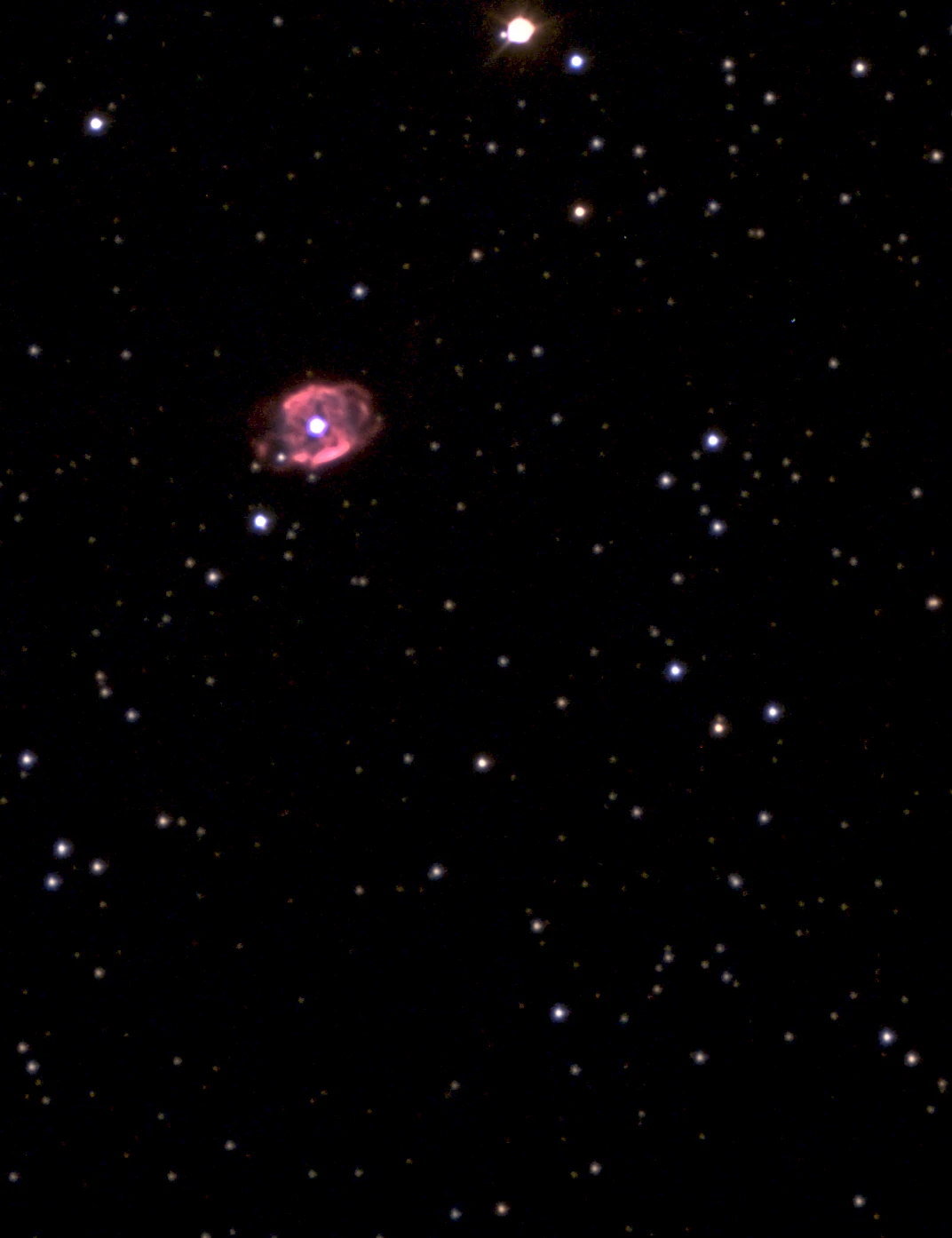
C2 / Bow Tie Nebula / NGC 40
| Name | Bow Tie Nebula |
| Designation(s) | C2, Bow Tie Nebula, NGC 40 |
| Object Type(s) | Planetary Nebula |
| Relevant Catalog(s) | All (Chron), Caldwell, NGC |
| Obs. Lat/Long | 42° 17', 073° 57' |
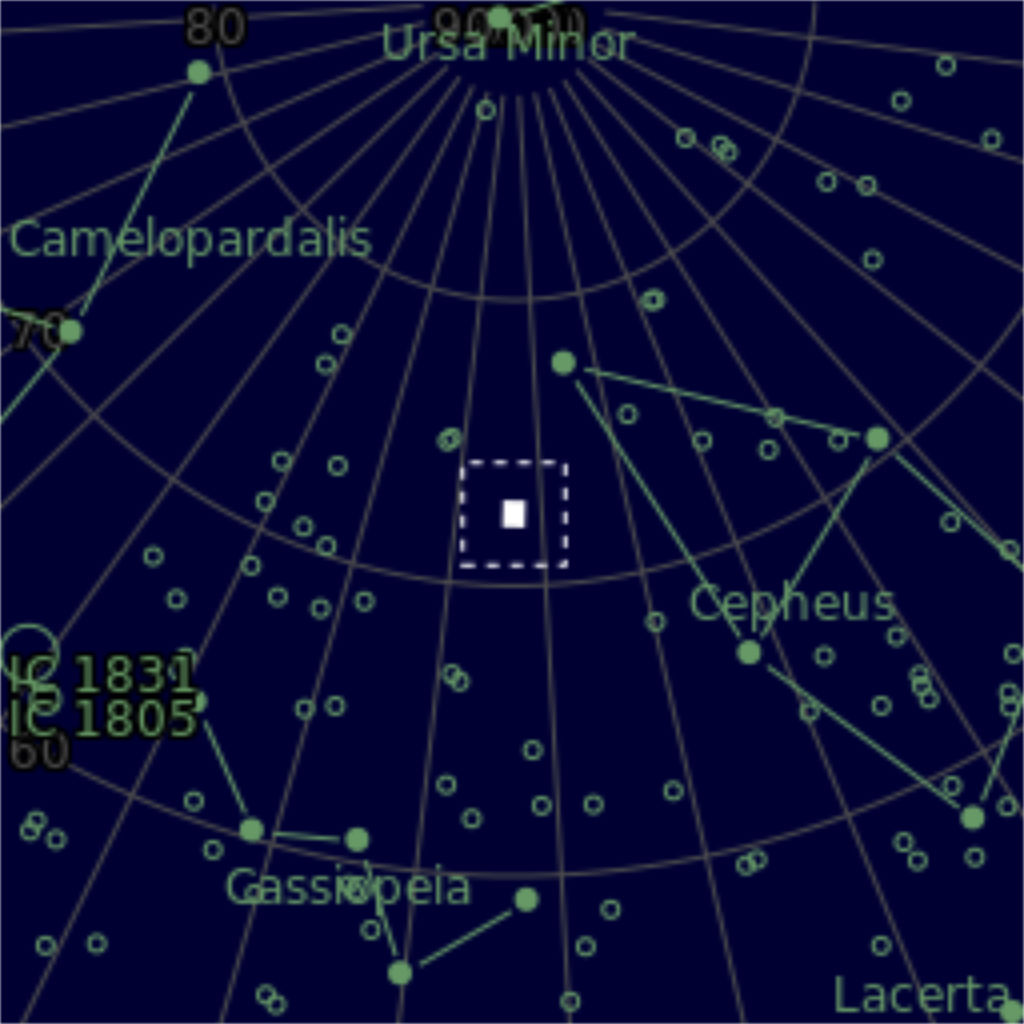
| Constellation | Cepheus |
| Date and Time Observed | 2024-10-08 21:00:00 |
| Instrument | EdgeHD 8" f10-2,032mm FL |
| Camera | ASI294MC-Pro |
| Image Details | Total integration time was 16m 45s. Exposures 15s@305g, UV/IR Cut Filter. Darks subtracted, no flats. Dithered and recentered in SharpCap. No guiding. |
| Description | Discovered by William Herschel on November 25, 1788, NGC 40 is a planetary nebula. It is hot gas around a dying star that has ejected its outer layer. Eventually, the star will collapse into a white dwarf, and the outer gas will fade from view. Most planetary nebulae are challenging, in part because they're tiny and bright. You need to stack them without blowing out any fine detail. This was fun to capture and satisfying in the detail that I achieved. [Postscript Added Dec 29 2025] While this is the first Caldwell object discovered by William Herschel, it is far from the last. Herschel (and Caroline, his sister) observed from Bath or Slough, 51.4 and 51.5°N respectively. This means they could have discovered only the first 67 Caldwell objects, the balance never rising above the horizon at their observatories. Of these 67, William discovered 50 (76%) and Caroline discovered 2. Add in one target discovered by son John, and the Herschel family accounts for 82% of the 67. Of the 11 objects they didn't discover, a) Four are nebulae that would have required viewing through filters to see optically (C9, C19, C31, C63), b) three are low surface brightness galaxies -- the only ones they truly missed -- C5, C51, C57, c) two are pre-telescope objects (C14, C41), and d) only two pre-date the Herschel's with telescope discoveries of open clusters (C50, C64). Remarkable. |
| Catalog Links | <Previous | All Listings | Next> |