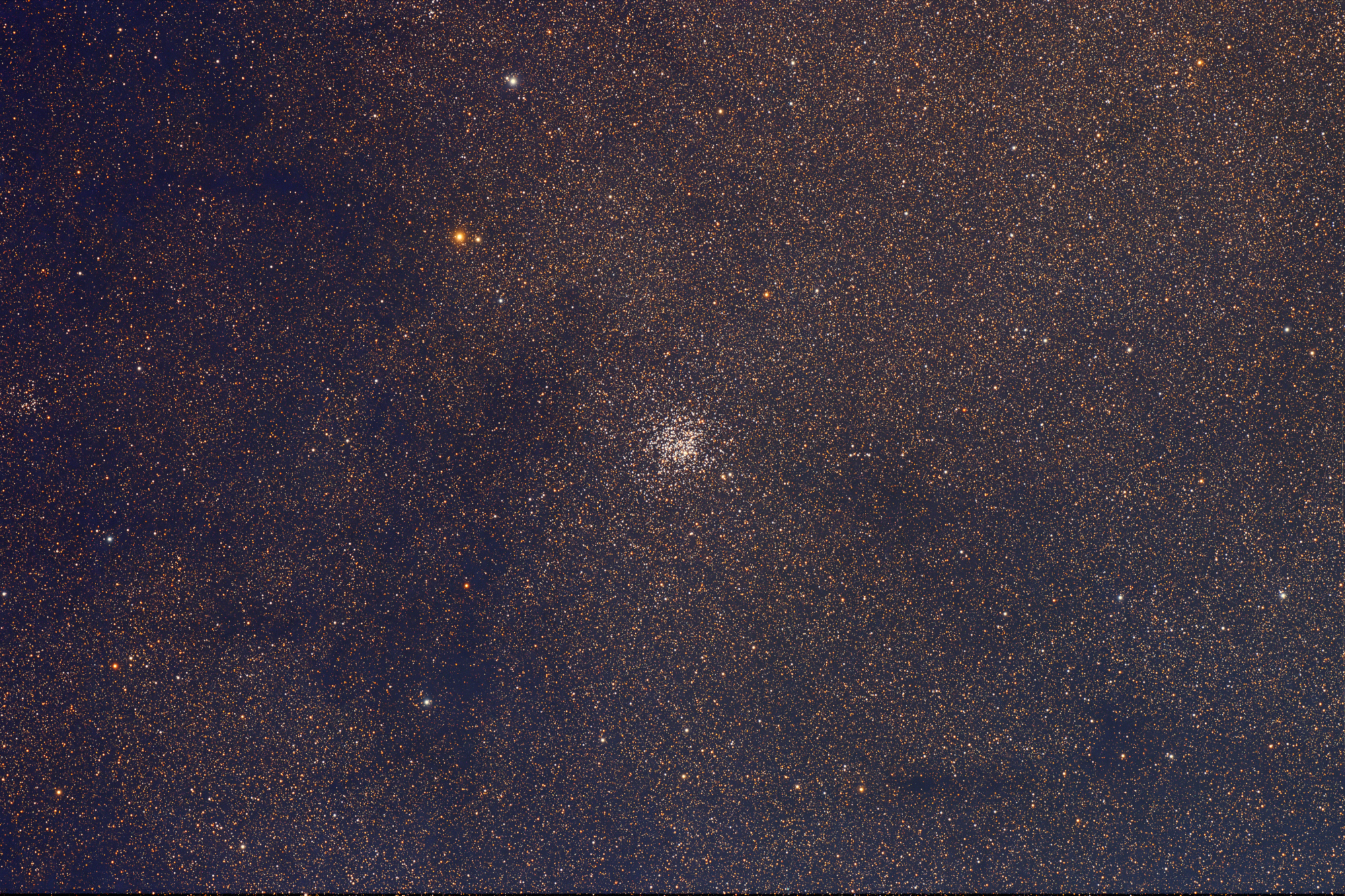
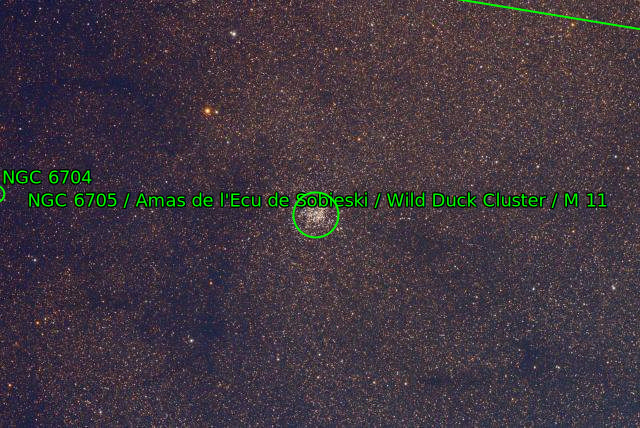
M11 / Wild Duck Cluster / NGC 6705 – Revisit

NameWild Duck Cluster
Designation(s)M11, NGC 6705
Object Type(s)Open Cluster
Relevant Catalog(s)All (Chron), Messier, NGC
Obs. Lat/Long42° 17', 073° 57'
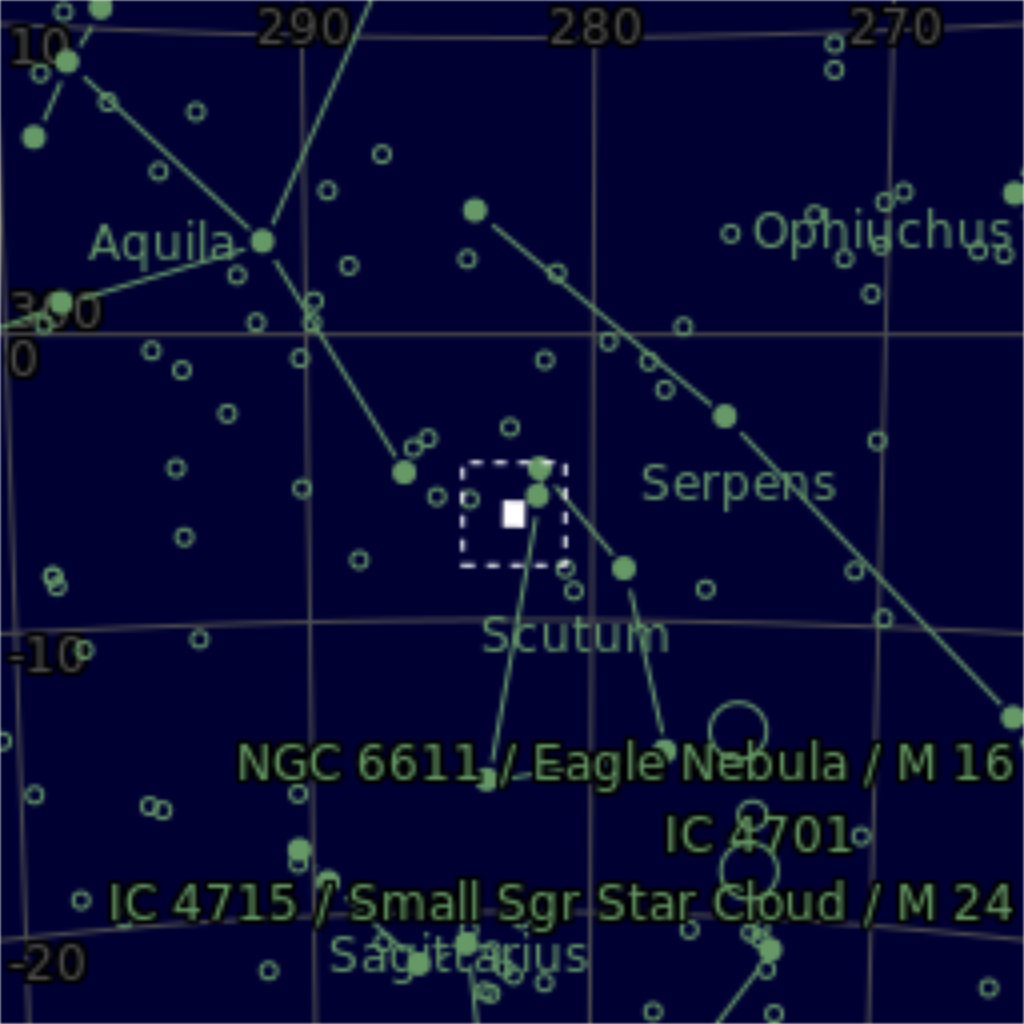
ConstellationScutum
Date and Time Observed2026-07-13 23:45:00
InstrumentAskar V 80mm w extender f7.5-600mm FL
CameraASI2600MC-Pro
Image DetailsUp is 90.7 degrees E of N. Transparency: Good. Seeing: Good. Total integration time was 9.25. Exposures 15s@101g. Dithered and recentered in SharpCap. No guiding.
DescriptionM11 was discovered by the German astronomer Gottfried Kirch of the Berlin observatory in 1681. It was apparently first resolved into stars by William Derham about 1733. Charles Messier included it in his catalog on May 30, 1764: "Cluster of a great number of small [faint] stars, ....which one can see only in a good instrument; with an ordinary telescope of 3 feet [FL] it resembles a Comet:". <--> This is a dense "open" cluster, located right on top of the Scutum Star Cloud. Frankly it looks more dense than M4, which is categorized as a Globular Cluster. In the 20th century, astronomers would recognize that GC's are some of the oldest stars in the Milky Way, and can be distinguished by low "metalicity" (that bizarre habit of astronomers to describe as a "metal" any element heavier than Helium). GC's were formed from pristine clouds of mostly Hydrogen. OC's had more metals, but this is a distinction that needed a couple of hundred years to establish. In this earlier era, it was driven by the ability of Messier's telescope to resolve individual stars (as here). Whether OC or GC, this is a handsome cluster.

But what really makes it fascinating is its position on the central Milky Way star cloud. I thought the previous attempt was a bit garish, though fun. Check it out but hitting the "related observations" link here.
Related Observations    
Catalog Links
 Messier Listings 
Featured Image