
Arp’s Peculiar Galaxies
Page 11 of 18
Arp observations 101-110 of 179 total to date.
| Thumbnail | Title/link | Arp Category | Date Observed | Observer Description |
|---|---|---|---|---|
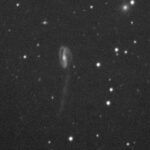 |
Arp 188 / Tadpole Galaxy / UGC 10214 | Galaxies with narrow filaments | 2024-10-24 20:19:00 | Something dragged out the tail, but it's not immediately apparent what. Arp remarks: "Disturbance inside W arm, filament may originate there." This is a disturbed, barred spiral galaxy. While filament does indeed seem to originate in the western arm, and continue out on the same plane as the disk, stretching out an enormously long "narrow filament". Something else seems to have glommed onto the top of the disk defining a second plane, obscuring a section of the western arm. An incomplete merger? Could the merger be the disturbance that triggered expelling the filament? |
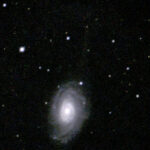 |
Arp 189 / Umbrella Galaxy / NGC 4651 | Galaxies with narrow filaments | 2024-05-01 22:38:00 | This is a very bright and reasonably large galaxy, where the "handle", a faint, vertical dust lane, became evident after about 30m of integration. Clouds shut down observing after 55m. Affinity Photo processing of the .png image saved "as adjusted" in Sharpcap makes it more apparent at the cost of a much noisier background. As part of my pre-submission review, I processed the monochrome, inverted version which makes the "handle" even more evident. In most other respects this spiral galaxy appears normal. It is slightly elongated vertically, and the outer arm of the spiral is slightly detached from the rest of the disc, both consistent with a gravitational attraction from the top of the image. There do seem to be some tiny galaxies in the region where the handle terminates, evident in both the color and inverted images. However, I wouldn't want to speculate whether they are attracting the "narrow filament" or some other process is responsible. |
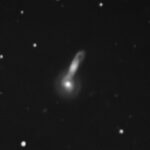 |
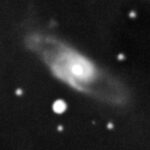
Arp 199 / NGC 5544-5 | Galaxies with material ejected from nuclei | 2025-09-21 21:07:00 | These two galaxies were discovered by William Herschel on a very productive night in 1785. He originally classified it as a single galaxy. 40 years later his son, John, saw them clearly enough to separate them into two. Arp found the interaction interesting, but seemed to focus on "material ejected from nuclei". |
 |
Arp 200 / NGC 1134 | Galaxies with material ejected from nuclei | 2026-03-02 20:29:00 | Combining Arp's category (galaxies with "material ejected from nuclei") with his observing remarks: "Splash appearance on W side of galaxy points to low S[urface].B[rightness]. comp[anion galaxy]. 7' S." There's a comparison image in the gallery with arrows pointing out the companion, and a Hubble image follows that removes any doubt that that companion exists. The "splash appearance" is the mottled structure (barely visible in my image) just left of the companion, and behind the companion in the Hubble image. This is classic Arp, who was heavily influenced by Armenian astronomer Viktor Ambartsumian who argued for similar ejections from what we would today call AGN (active galactic nuclei, or supermassive black holes). |
 |
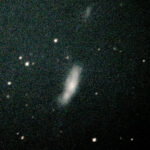
Arp 204 / VV 39 | Galaxies with material ejected from nuclei | 2026-02-24 21:30:00 | Arp 204 is a tiny (1' x 0.3') and dim (15.8 mag) galaxy (cluster?) within 6° of the celestial pole. As usual, Arp doesn't really say except through categorizing this as galaxies with "material ejected from nuclei" - implying one galaxy with detritus. Most modern commentators suggest this is a galaxy cluster with three members connected by a prominent stellar bridge. Arp was heavily influenced by Armenian astronomer Ambartsumian to see companion galaxies formed by "ejections". In modern terminology, we'd call this ejections from AGN. But most observers don't believe these ejections appear as fully formed galaxies, and most would see this as at least two galaxies connected by a tidal tail, perhaps the result of a near miss, and possibly presaging an eventual merger. Russian astronomer Boris Vorontsov-Velyaminov created the VV catalog of interacting galaxies: he'd been given a set of the Palomar Sky Survey. (POSS) plates, an unusual "scientific exchange" in 1958 at the height of the cold war. Arp used the VV catalog as one of his inputs when selecting his Atlas of Peculiar Galaxies. |
 |
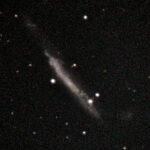
Arp 205 / NGC 3448 | Galaxies with material ejected from nuclei | 2024-04-22 23:10:00 | I struggled with Arp 205, because it's hard to know why this target is categorized as containing "material ejected from nuclei". What does that look like? Arp left no comments that might offer insight. Technically, it's doubly tough because you have a mix of high and low surface brightness objects: I tried my usual grayscale and inversion tricks here. Despite the normal infirmities of OSC imaging, color helps more than you'd expect, and I couldn't improve on my original color captures. Describing the bright object from the bottom left to upper right (NW to SE) NGC 3448 (discovered by William Herschel in 1789.) looks more like two galaxies, not one. There are clearly two galactic nuclei here associated with spiral disks. The first disc is foreshortened, at a different plane from the second, enlongated., Then there's a 3rd spiral disk, tucked in where the brightness ends, at yet another angle, a tiny nucleus, and despite low brightness, showing up as a gray disk against the green/black background. Finally there's the smudge towards the SW corner, disconnected from the other three. I can't see much of it, but what I can see has the distinctive shape of a S barred spiral center. From a modern perspective you know that it's UGC 6016, and a cataloged 17th magnitude galaxy. Arp, of course, didn't have that advantage, but his plate shows the galaxy pretty clearly, even if it's surrounded by other junk, That leaves only the tail NE of NGC 3448 (lower left), which is shown very clearly in Arp's plate, and which my image only hints at. Could that be ."ejected material"? But how is that different from a narrow filament? And why does that trump 4 galaxies interacting together as a reason for peculiarity? |
 |
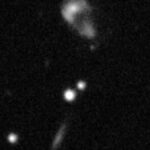
Arp 206 / NGC 3432 | Galaxies with material ejected from nuclei | 2024-04-21 23:15:00 | Arp 206 consists of an edge-on spiral galaxy (NGC 3432) of magnitude 11.3 interacting with a magnitude 16.3 galaxy, UGC 5983 (the little smudge slightly higher than the lower edge of 3432's disk, i.e. SW from the center or NW from the edge). A more likely candidate for "material ejected from nuclei" is the material to the NE (upper left}. At least it's ub the same plane. And the NE end of the central disk looks disrupted. But what suggests it's an ejection and not a merger? |
 |
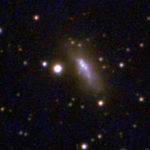
Arp 208 | Galaxies with material ejected from nuclei | 2025-06-01 23:15:00 | A brief opening with late-clearing clouds. I wanted to capture more time, but clouds intervened. One of the fun things about observing Arp galaxies, is that Arp's judgements are far from infallible. This seems to be an example. The category states we're looking at a "ejected" material -- presumably the amorphous structure vaguely connected to a semi-circular disk. Instead i'd interpret it as an incomplete merger, with tidal filaments connecting the two merging galaxies. |
 |
Arp 210 / NGC 1569 | Galaxies with irregularities | 2024-02-29 00:00:37 | The long axis of this galaxy is oriented from SE (upper left) to NW (lower right). I suppose you could describe it as a barred spiral, but in a "normal" barred galaxy you'd expect a single, central bright nucleus, whereas Arp 210 exhibits 5 bright spots within the "bar". Three are in a line close to the SE end. The fourth is rotated SSE from the third spot. The fifty, final bright spot is close to the NW end, continuing the line of the first three after a long gap. The central bulge appears slightly bent on the z axis, with a slight kink -- down and up -- at the second bright spot, and a distinct bend between the third and the final spot. The NW (lower right) hemisphere disk appears thick and intact. The SE hemisphere appears to have been disrupted. Irregular indeed! It certainly gives the impression of a spiral galaxy that has incompletely absorbed a number of smaller galaxies. |
 |
Arp 212 / NGC 7625 | Galaxies with irregularities | 2024-10-26 20:03:00 | Arp remarks: "Narrow chaotic absorption tubes across one end". I had to look up "absorption tube" and I'm not sure I found the correct answer. The term can describe the phenomenon where light from a distant galaxy passes through a cooler gas cloud, causing specific wavelengths of light to be absorbed, creating "absorption lines" on the galaxy's spectrum. Presumably this refers to the white tubes in the inverted images which are mostly on the S end of NGC 7625. These are consistent with a cooler feature (will be darker in reality). It was easier for me to sharpen the image in inverted space, and the reason why the featured image is inverted. Anyway, even though it's quite small, this target was engaging and beautiful. This was my third outing with my new, Player-one Apollo-Mini monochrome camera and I started feeling comfortable with it. While occasionally color helps interpret an image, much more often the greater sensitivity of the mono camera makes for a more detailed image, as in this case. |