Arp’s Peculiar Galaxies
Page 13 of 18
Arp observations 121-130 of 179 total to date.
| Thumbnail | Title/link | Arp Category | Date Observed | Observer Description |
|---|---|---|---|---|
 |
Arp 233 | Galaxies with the appearance of fission | 2024-02-21 00:00:35 | This is a tiny object which stresses the limits of my 8" SCT with 294 sensor. Frankly, the 18m of integration was totally inadequate. I was new to this and clearly didn't know what I was doing. That said, the "appearance of fission" is tough to see, even in Arp's imagery, and I'm not sure even a few hours with my equipment would suffice. I've taken my best shot at identifying the fission in image #2 using Arp's plate. As well, Arp remarks, "Narrow faint absorption lane in SE direction". This makes another subtle appearance on Arp's plate which I illustrate in image 3. |
 |
Arp 234 / NGC 3738 | Galaxies with the appearance of fission | 2025-01-03 22:37:00 | Because of its irregularity, this is a very challenging object to interpret. "The appearance of fission" presumably suggests the galaxy is breaking apart. Yet Arp's remarks suggest, "Considerable resolution into stars and absorption tubes", Absorption tubes I can somewhat understand. There do seem to be dark veins running along the surface. They're more clear in Arp's (Oh, what I would give for a 200" telescope and clear mountain air"), but you can see corresponding veins in my capture. But fission? I don't see anything here that suggests fission. Indeed, current consensus is that this is an area of active star-birthing. See: https://esahubble.org/images/potw1243a/ |
 |
Arp 235 / NGC 14 | Galaxies with the appearance of fission | 2024-10-26 22:22:00 | This is a puzzling galaxy with what looks like at least 2, and possibly 3, elliptical galactic nuclei at slightly different orientations. The result is a galaxy with a much larger and more elongated, irregular center than normal. Arp categorizes this as having "the appearance of fission", and I suppose that's possible if you thought that there exists a mechanism for fission. Arp believed in galactic fission... but it runs totally against mainstream cosmology. Mergers seem like such a simpler explanation, and Occam's Razor applies in my mind. I certainly think that incomplete fusion is the simpler explanation of the appearance here. I did give Arp the benefit of the dark here. To my mind the plate is overexposed, so I worked on it and "developed" a positive image to see if there was something I was missing. Arp does call out the "faint outer oval" in his notes, and I tried to enhance the positive view of the plate to provide a balanced appearance. I did notice two, low surface brightness companions, close by, SW of the disk. Does that change the argument? Not in my mind. |
 |
Arp 238 / UGC 8335 | Galaxies with the appearance of fission | 2025-07-30 22:30:00 | Welcome to the "Way Back Machine" where Arp suggests this target provides "the appearance of fission," i.e. looking like a single galaxy pulling itself into two. This is another example of the reluctance to suggest a merger. In part through the examples provided by Arp, the astronomy-world began to understand that mergers were common events in the evolution of most major galaxies. |
 |
Arp 239 / NGC 5278-5279 | Galaxies with the appearance of fission | 2025-08-27 22:54:00 | Two, reasonbly bright NGC galaxies pretending they're M-51. There's an obvious connection from 5278, the larger galaxy, to 79 via a heavy arm. Less obvious connection between the two nucleii. |
 |
Arp 240 / NGC 5257 and 5258 | Galaxies with the appearance of fission | 2025-07-21 22:16:00 | Arp categorizes this pair of interacting galaxies as providing "the appearance of fission". You can see why... two elongated galaxies roughly the same size, roughly mirroring each other. The best telescope in the world renders them with little internal structure visible. Could they have been, originally, one galaxy, somehow split apart? Continuing to share stars and other matter as they continued to separate? Possibly. At the time, galaxy mergers were thought nearly impossible due to the immense distances involved. So "fission" -- even absent any theoretical framework -- seemed a valid possibility. And welcome to the mid-1960s when some of the best observers in the world -- using the best telescopes in the world -- were seeing these phenomena for the first time and struggling to figure them out. |
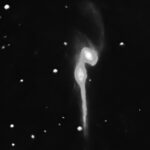 |
Arp 242 / NGC 4676 / Mice Galaxies | Galaxies with the appearance of fission | 2025-03-26 01:00:00 | We're seeing two small spiral galaxies approaching a merger. The "tails" are tidal tails... the closer ends of the galaxies experience much greater gravitational attraction than the far ends. As the galaxies move towards each other, the far ends leave behind some stars. Arp didn't believe in galaxy mergers which seems strange today. He notes "Very thin, bright tail from north nucleus which has strong absorption," but categorized the peculiarity as the "appearance of fission". How two perfectly formed spiral galaxies could be established from a "fission" seems so much more complicated than the modern consensus that galaxy mergers are commonplace. Arp was observing phenomena which few other astronomers were paying attention to -- indeed he was paddling upstream against the orthodoxy that was trying to identify regularities, not peculiarity. Bottom line, in this case, I think his "fission" idea is dead wrong. But given the state of knowledge at the time, the phenomena were worth pointing out even if the implied explanation was incorrect. A fun capture on a clear night with crummy seeing as evidenced by every visible object twinkling noticeably. |
 |
Arp 244 / Antennae Galaxies / C60 | Galaxies with the appearance of fission | 2024-05-02 22:17:00 | Discovered by William Herschel in 1785, and included in Halton Arp's "Atlas of Peculiar Galaxies". This is an entertaining target showing two bright galaxies in an intimate embrace, with a long narrow filament extending behind, and appearing to terminate at a tiny dwarf galaxy. The filaments are quite evident in the color image; if you can't see them, please boost the brightness on your monitor and zoom into the image. Fission or merger I suppose are symmetrical notions, so one can draw either conclusion from the heavily distorted structures; somewhat evident in NGC 4038 (right), and largely destroyed in 4039. While the notion of a merger is well accepted now, Arp usually interpreted galaxies as breaking apart or ejecting matter. Hence his categorization of these "with the appearance of fission". I remain skeptical though admire his contrarian spirit. |
|
Arp 244 / Antennae Galaxies / C61 | Galaxies with the appearance of fission | 2024-05-02 22:17:00 | See C60 for writeup. |
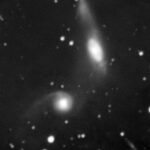 |
Arp 245 / NGC 2992 / NGC 2993 | Galaxies with the appearance of fission | 2026-03-08 21:00:00 | Another case where my monochrome CMOS camera is capable of capturing a deeper image than Arp's 200" using Emulsion D (the "standard" emulsion). "Very faint diffuse connection from both ends of N spiral to S spiral" aren't so faint in my capture, likely the result of longer wavelength emissions through near-IR. Appearance of fission? Arp abhorred what he called "merger mania" and rarely interpreted interacting galaxies as merging. Still, it appears more likely a merger in process than "fission". |