Arp’s Peculiar Galaxies
Page 14 of 16
Arp observations 131-140 of 155 total to date.
| Thumbnail | Title/link | Arp Category | Date Observed | Observer Description |
|---|---|---|---|---|
 |
Arp 282 / NGC 169-169A | Galaxies with infall and attraction | 2024-12-12 21:42:00 | Considering this was captured on a 93% moonlit night, it's pretty amazing, and testament to the power of the Apollo M-mini mono camera. All of the key details, particularly the dust trail to the lower right on IC 1559 (the dwarf galaxy), are visible, which I interpret as stars left behind while the bulk of the dwarf galaxy is drawn into a merger with NGC 169. It's even more clear in an inverted rendering of my image. As usual I prepared a direct comparison with the plate published in Arp's Atlas of Peculiar Galaxy, which shows the ultimate image using 1960s technology. I couldn't resist adding a Hubble Space Telescope image I found on Wikimedia Commons, licensed under a Creative Commons 2.0 license (and anyway, as based on Hubble data, inherently public domain). This shows how much technology improved in roughly 40 years. Of course the idea that I could capture an inferior, albeit adequate, image in half an hour from my back yard is mind blowing. I would have extended the capture, but high clouds were starting to trigger brightness filtering so I shut this capture and moved to another part of the sky. |
 |
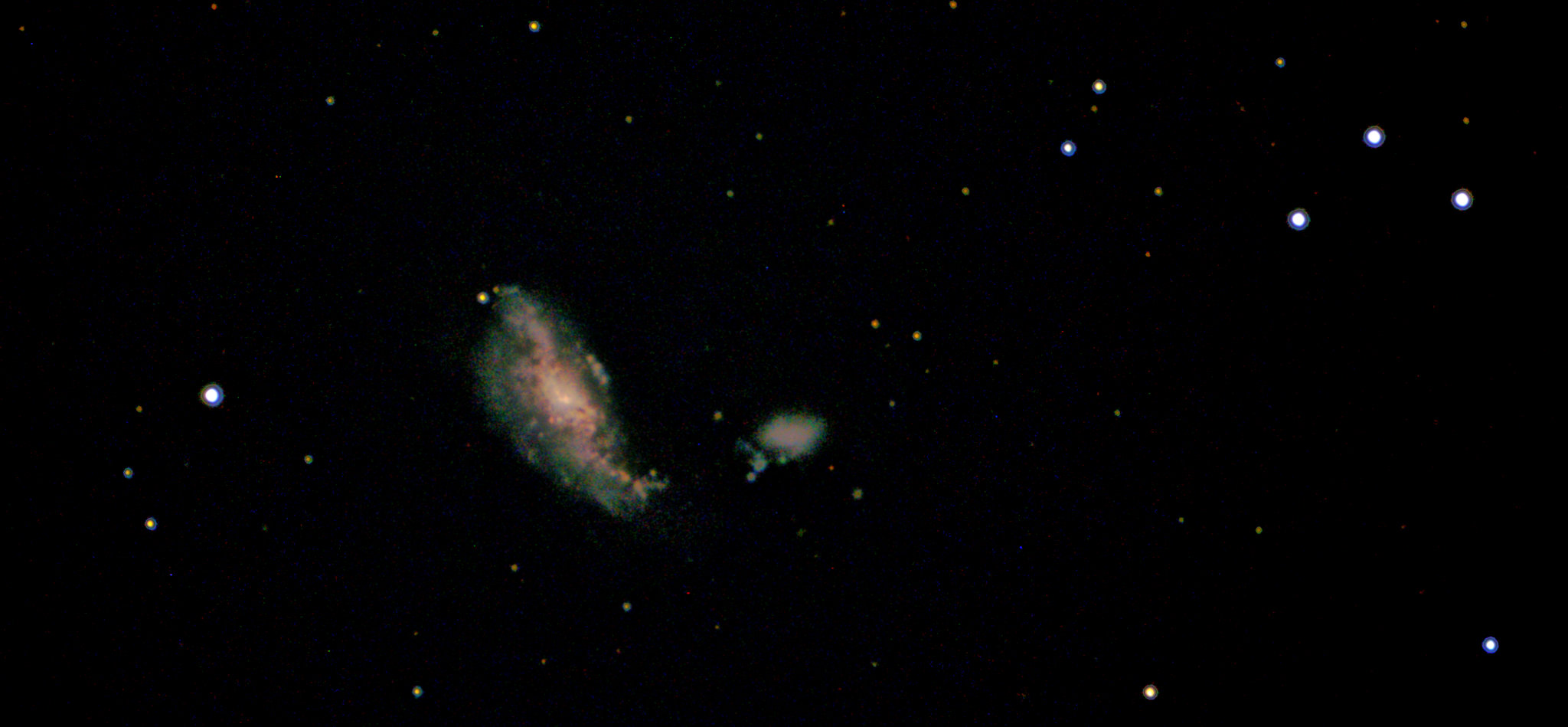
Arp 284 / NGC 7714 / NGC 7715 | Galaxies with infall and attraction | 2023-10-10 22:30:32 | There are two obvious galaxies in the frame: NGC 7714 is a distorted, more or less round, spiral galaxy in the center of the image that appears to be attracting stellar material from above and below. Below, the new material deformed a large spiral arm, out- and downwards. 7714 has a very bright galactic nucleus and the rest of the spiral disk is bright and well formed. NGC 7715 is much less bright, with a dim center. We appear to be viewing it edge-on, distorted into an integral sign shape that runs right to the edge (and behind?) 7714. The fact that 7714 is brighter and more intact suggests it is the dominant galaxy of the two. I'm wondering if the bright spot just below 7714 is a dwarf companion also in the process of "infall". Arp doesn't mention it in his notes, so may not be likely. Still it does have a suspiciously companion-like structure. |
 |
Arp 285 / NGC 2854 / NGC 2856 | Galaxies with infall and attraction | 2024-02-05 00:23:30 | Captured in a combined image with Arp 1. These two emerged first, substantially brighter than Arp 1. The foreground galaxy, NGC 2854, is a spiral, barred galaxy forming an extended "S" curve pointing directly to NGC 2866 with a hint of a dust lane connecting them (seen more clearly in the Arp plate); NGC 2856 is a more regular, compact spiral. A jet visible in the Arp plate shoots in the general direction of Arp 1, explaining Arp's description that a "Narrow tail leads away from northern nucleus." The "jet" is not visible in my capture neither in color nor inverted grayscale. |
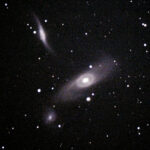 |
Arp 286 / NGC 5560-5566-5569 | Galaxies with infall and attraction | 2024-06-07 23:07:00 | Captured during a brief, clear window during an otherwise cloudy new-moon night. Transparency was suspect though SharpCap's brightness filter stayed quiet until near the end of the capture. Arp 286 embodies 3 wildly interacting galaxies. NGC 5566 is the elongated spiral galaxy in the center; lower-diagonal-left is NGC 5569, a dwarf spiral with extensive filaments connecting it to 5566. These can be readily seen both in my inverted image, and in Arp's. One small arm of 5566 has been pulled away slightly by the interaction. Switching to NGC 5560 (upper-left), it is an extreme barred spiral, with the lower arm pulled towards 5566 and exhibiting filaments "nearly" connecting them. The classic S curve of such galaxies in this case is slightly asymmetrical, and expanded in the direction of 5566. The filaments are also longer in that direction. Arp remarks that "Connection not visible", presumably describing this connection since the other does appear visible. Ultimately, I presume that both of the smaller galaxies will end up merged into 5566, though it's possible 5560 has already "missed" 5566 and is now moving away. The extreme barred structure suggests it's been interacting for a very long time. |
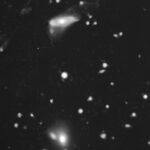 |
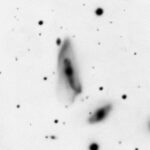
Arp 288 – NGC 5221 and 5222 | Galaxies with the appearance of wind effects | 2025-07-21 22:14:00 | I believe this is the first Arp object I've observed which is categorized with the "appearance of wind effects". It's an evocative description, and certainly appropriate. As Arp remarks in his recorded notes: "Streamers in both directions from edge of spiral," presumably describing the appearance of NGC 5221. The big mystery is what caused this level of tidal tails... certainly NGC 5222 doesn't seem up to it by itself. Possibly it's responsible for the relatively short lip that points downwards. But the long tail? That requires some serious motion and mass. |
 |
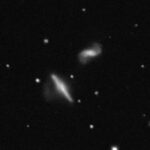
Arp 290 / IC 195 and 196 | Galaxies with the appearance of wind effects | 2025-11-22 21:29:00 | This is a very peculiar galaxy. Wind effects? Yes, it does appear that way, especially in the inverted images, and especially in Arp's. It looks like a galaxy weeping stars. The result of an interaction with the smaller galaxy, or something else. A mystery. |
 |
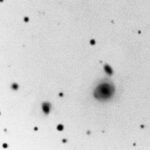
Arp 293 / NGC 6285-6286 | Galaxies with the appearance of wind effects | 2025-06-29 23:33:00 | A straightforward observation on a good observing night. 12m is relatively short integration, but I could see in SharpCap that the tidal "fields" that evidence interaction were quite visible, and the overall size of the target wasn't going to support much more structure or detail. |
 |
Arp 297 / NGC 5754 – 5752 | Double or multiple galaxies with long filaments | 2025-06-12 00:39:00 | Captured on a full moon night with even a little smoke, which improved the later it got. I believe it's important to capture the feature Arp cared the most about, and in this case its the tidal filament extending from the bottom of NGC 5754 and looping up and to the right connecting it to NGC 5752. The additional filaments out of NGC 5755 probably increased the peculiarity. While conditions were far from ideal, the image was building slowly and I could just start to see the filaments at about 50 minutes. In the conditons, I'm pleased I can see it at all. |
 |
Arp 298 / NGC 7469 with IC 5283 | Unclassified double galaxies | 2024-10-28 22:26:00 | This is one of the more unusual Arp Catalog entires: two galaxies in close proximity. The only suggestion that they are interacting is a slight twisting of an arm in the small galaxy (IC 5283) towards NGC 7469, an elongated core, and a slight suggestion of a dust trail. NGC 7469 appears to my eyes as being type S0 - aka Lenticular -- intermediate between a spiral and elliptical. There remain clear spiral structure in the core, which is fading in the outer envelope.. |
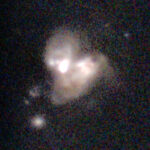 |
Arp 299 / NGC 3690 / IC 694 | Unclassified double galaxies | 2024-05-24 23:07:00 | Another surprisingly good capture given a waning moon just a couple of days past full. Luckily aiming directly away. These galaxies are astonishing. Two appear so well integrated that they have a single NGC number instead of two consecutive, or, as you see often an A/B. They both seemed to be irregular barred galaxies that, by this point, have merged galactic centers. Even Arp seems resigned to the fact in his remarks: "Bright internal knots." The dwarf IC 694 seems to be sucked in from the bottom of the image as well. |