
Arp’s Peculiar Galaxies
Page 17 of 18
Arp observations 161-170 of 179 total to date.
| Thumbnail | Title/link | Arp Category | Date Observed | Observer Description |
|---|---|---|---|---|
 |
Arp 304 / NGC 1241 and 1242 | Unclassified double galaxies | 2025-11-22 22:28:00 | Arp 304 consists of two galaxies NGC 1241 and NGC 1242, left to right and a double star to the southeast, NGC 1243. The two galaxies were first seen by William Herschel. John Herschel, unable to see 1242 recorded the double star NGC 1243. Dreyer saw all three but recorded the double star as a nebula. Arp didn't seem too fussed as he left no remarks. The only peculiar structure seems to be a slightly enlarged arm on NGC 1241 pulled away in the direction of NGC 1242. |
 |
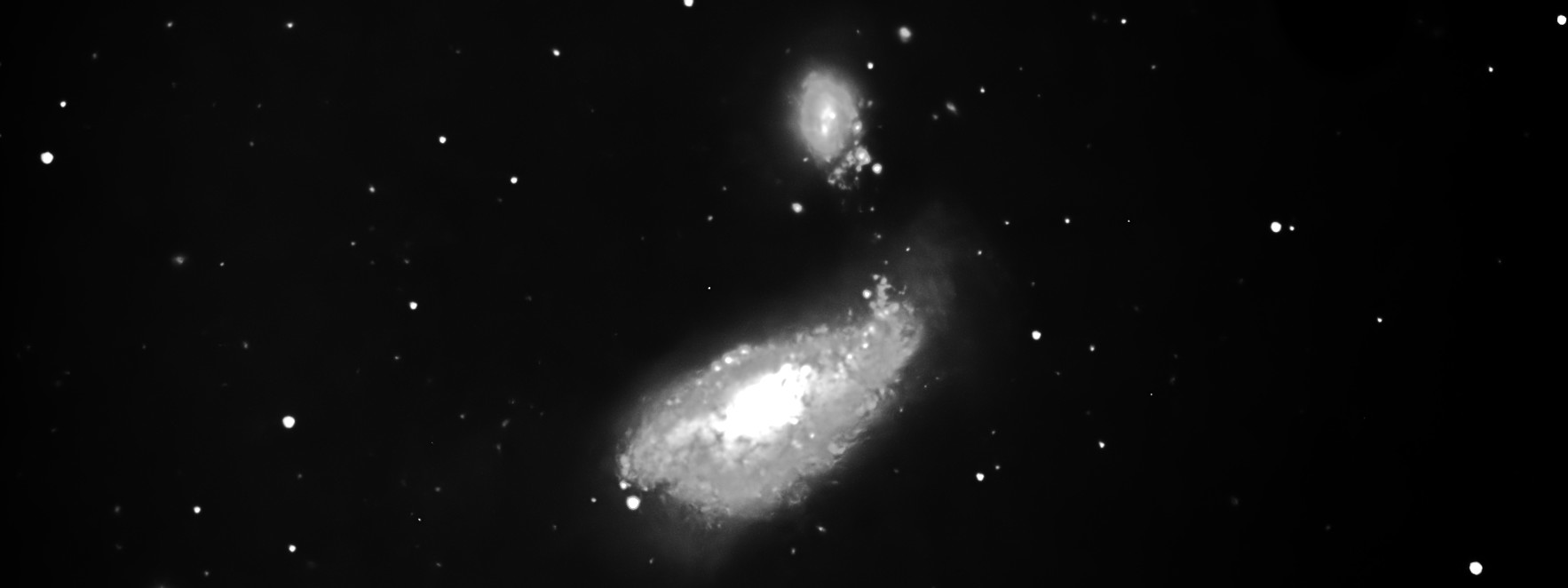
Arp 305 / NGC 4016 / NGC 4017 | Unclassified double galaxies | 2026-03-27 23:00:00 | Arp's comment on this pair of galaxies suggests he was intrigued, "Segment breaking from arm of S gal., weak filaments reach to N gal., which has figure 8 loops." My initial reaction was that we were looking at tidal debris, the legacy of a fly-by, though I was puzzled by the linear splotch, the most visible part of an incomplete debris trail connecting them, slightly closer to NGC 4017. Turns out Arp 305 has been studied recently, and that "splotch" is a cluster of Compact Dwarf Galaxies, created in the debris from the fly-by, representing areas of significant star formation. I provide links to the papers at the bottom of the page, below the gallery. |
 |
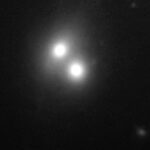
Arp 307 / NGC 2874-2873-2872 | Galaxies with concentric rings or Double Galaxies(?) | 2025-01-26 20:10:00 | This is a lovely cluster, but hard to interpret. Sources don't agree on how Arp categorized it: Kanape and Webb list it as "Double Galaxies" The AL list has the category as having "concentric rings" presumably referring to the lenticular galaxy NGC 2974 alone. The Cal Tech website doesn't list its category. Anyway, judging from the halos around the galaxies, which are most clear in the inverted images (either mine or Arp's) it looks to me that 2974 and 2972 are interacting, and it's ambiguous if 2973 has joined the fun. That said, Arp left a cryptic set of remarks: "Position between pair. Possibly not interacting. " It's ambiguous whether he's referring to 2972 (the medium sized elliptical) or 2973 (the small spiral). |
 |
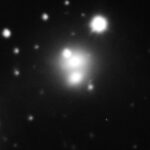
Arp 308 / Abell 194 | Unclassified double galaxies | 2025-01-23 19:23:00 | This was a "2 for" - a second Arp galaxy group within the same FOV as "Minkowski's Object" (Arp 133). It consists of two interacting galaxies (L to R): NGC 545, a lenticular galaxy, and NGC 547, an elliptical galaxy. During capture I noticed an extended halo from NGC 545 up and to the right towards Arp 133 (southeast given that N is left in these images), which became more pronounced after processing. Arp, himself, doesn't mention it in comments, saying: "Close ellipticals. Position of central galaxy (NGC 541)". |
 |
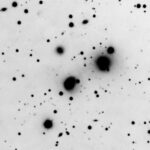
Arp 310 / IC 1259 | Unclassified double galaxies | 2025-08-27 23:58:00 | Arp describes this object as "Very close E galaxies". Famously brief, I'm guessing he's interpreting the 3 nuclei as each belonging to separate galaxies, though I would venture a more common description today might be, "3 merged -- or merging -- galaxies where the nuclei are still distinct". Note Arp remarks further: " Picture is 10X [magnification] of following (No. 311) area". |
 |
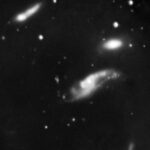
Arp 311 / IC 1258, 1259, 1260 | Unclassified double galaxies | 2025-08-27 23:58:00 | Arp is positively fulsome in his description here: "Same as 310, but shows surrounding field and group. Picture is 4X of preceding (No. 310) area". The two larger galaxies (IC 1258 and 59) certainly do appear to be exchanging mass. The connection to IC 1260 is a little more tenuous but still suggested. |
 |
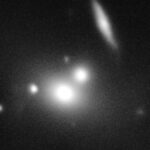
Arp 313 / NGC 3995 / NGC 3994 / NGC 3991 | Groups of galaxies | 2026-03-28 00:42:00 | ARP 313 is a trio of interacting galaxies. The biggest member in the center is NGC 3995, to the west (upper right) is NGC 3994. The glowing galaxy to the northwest (upper left) is NGC 3991. Arp was taken with them, pointing out, "Linear strings of knots like deformed spiral arms. Strong [O II] emission" The "knots" presumably referr to both the distended arm of NGC 3995, and the entirety of 3991. The "strong [O II] emission" indicates what we today call a LINER galaxy, usually fueled by evolved, hot stars or a weak active galactic nucleus (AGN), presumably 3995. There's also a smudge below 3995, which could be a distant, edge-on galaxy, or perhaps a compact dwarf galaxy. |
 |
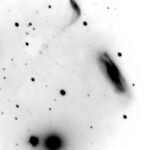
Arp 315 / NGC 2830 / NGC 2831 / NGC 2832 | Groups of galaxies | 2026-03-02 22:17:00 | Arp's criteria for selecting galaxy clusters are often opaque, and this is a good example. Here his remarks opine: "Companion E[lliptical] is quite compact". Presumably, this means he found the tightness of this grouping peculiar. NGC 2832 is the dominant E galaxy, NGC 2830 is the spiral galaxy to the upper right, and presumably NGC 2831 is the "compact" companion. These three galaxies are at the center of a much larger cluster, designated Abell 779 with at least 30 members. The original Abell cluster list was based on the 1958 Palomar Sky Survey, which didn't get terribly "deep" by modern standards. Today, it's tough to find an "official" count because people count galaxies in their images which invariably show many more galaxies than did Abell's 1958 POSS images. I've seen estimates between 32 and 80. Of course, many of the additional galaxies are background galaxies and not necessarily part of a real "cluster". |
 |
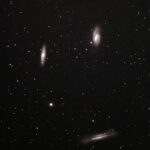
Arp 316 / NGC 3187 / NGC 3189 / NGC 3193 | Groups of galaxies | 2026-03-04 21:30:00 | This is a small cluster which Arp presumably included because he believed, "Edge-on spiral [NGC 3189] shows signs of interaction" - presumably referring to the lower arm curving towards the elliptical galaxy NGC 3193. This is one of the few images in the Atlas not taken with the 200" Hale Telescope. Instead it's one that Arp took using the 48" Schmidt. Remarkably, it delivers roughly the same FOV as my imaging setup: since my framing wasn't identical to Arp's, it turned out the corners of my image didn't quite cover Arp's, which i had to fill in (luckily blank in Arp's image as well). Today, the Vera Rubin telescope is frequently showing structures connecting neighboring galaxies which were historically thought separate, "connected" only by gravity. Arp was a pioneer in focusing on the faint signs of interaction visible though 1960s telescopes. |
 |
Arp 317 / M65 / Leo Triplet | Groups of galaxies | 2025-03-03 21:11:00 | Discovered by Messier (#29) on March 1, 1780 who recorded additional details in the entry for M66. Here he notes only: "Nebula discovered in Leo: It is very faint and contains no star." <--> This is one of my favorite targets, a stunningly beautiful group of three spiral galaxies. There are multiple observations here with different orientations. Tech details are for most recent triplet image, featured. M66 appears to be bent slightly by the attraction to M65. Arp seems to agree with me, as he remarks: "Both galaxies on east show signs of interaction." All three galaxies are quite bright, distinctly visible even after 60 seconds of integration. I have attached a "bonus" image which is a SeeStar 50 capture -- my first of the Triplet -- during a very dark and clear morning. This is the best galaxy capture I've achieved with this $500 automated telescope, and demonstrates what it can achieve when conditions are "perfect". I've also added to the gallery a capture from March of 2025, representing my first ever of M65 stand-alone, outside of the Triplet. Captured with my EdgeHD, 0.7x reducer, and Apollo M-Mini mono camera. |