
Focus Aids
Focusing a telescope is harder than you might think. But nothing is more important to the quality of your images.
I strongly recommend using a focus aid of some kind. You’ll want something that encourages you to focus frequently. That’s because temperature changes during the night can shift your telescope out of focus. Also, if you use an SCT, some suffer from “mirror flop”, where slewing from one target to the next may put your telescope out of focus. So checking focus several times during a session is good practice. In this discussion, I’m going to assume you’re observing with a camera.
- The better than nothing method is to point the telescope at or close to target, zoom the image to 100% or more, and focus until the stars get as small and tight as possible. You can do this manually as long as you can see a screen showing the star shapes. An EAF is a help, because touching a telescope causes it to vibrate and puts everything out of focus until it settles. Also, an EAF allows you to stay indoors, which can be a big deal in the Catskills during the winter.
- Bahtinov mask is similar. Here you place a specially designed screen on the front of the telescope while pointing at a bright star. In good conditions, the mask will generate a pattern centered on the star which will be perfectly symmetrical when in perfect focus.
An advantage of a Bahtinov mask is that it’s cheap (you can even find sites online that will give you a pattern to make your own), and relatively easy to use. Downside is if seeing is bad, it can be hard to see the pattern. It also forces you outside if only to put the mask on and off. On a cold night that can discourage re-focusing. - Assisted Bahtinov Mask. SharpCap has a Bahtinov mask assistant that does a fabulous job of helping you see the pattern in crummy conditions. Highly recommended if you’re committed to a Mask.
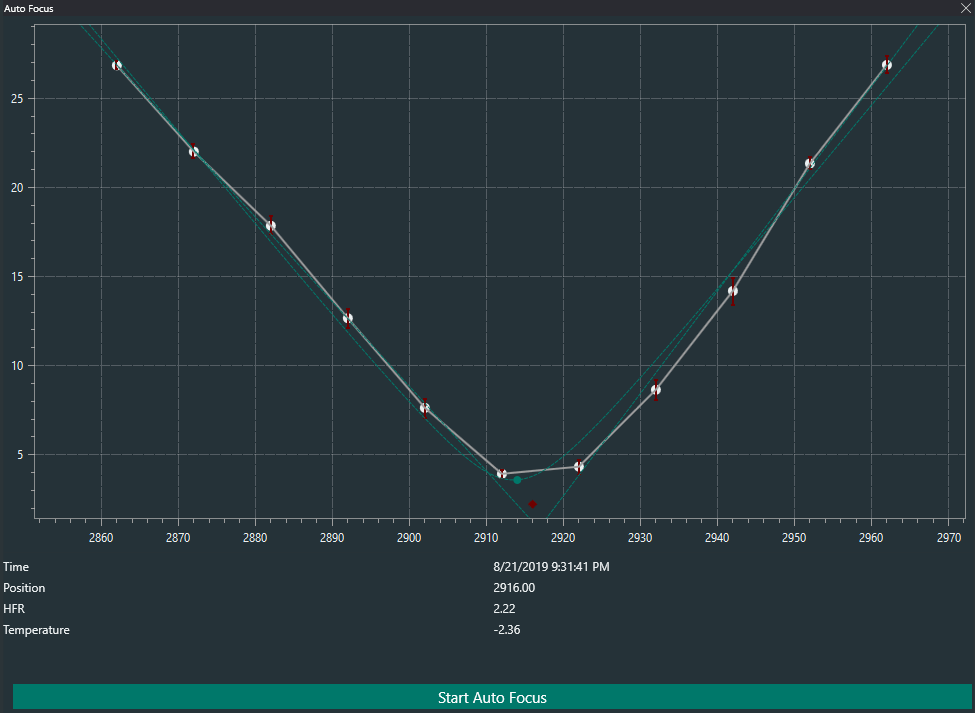
- Auto Focus Routines. SharpCap and NINA both have fully automated focusing routines. They work similarly with both detecting stars, measuring sharpness, and scanning across a series of focuser positions. Both perform a hyperbolic fit to estimate the point of maximum sharpness. I happen to prefer NINA’s and its Hocus Focus plugin, because I think its star detection is better, and the sharpness measure it uses, HFR, is more robust than SharpCap’s FWHM. That said, both have their fans and if you’re using SharpCap and not NINA, you may want to try getting it to work first.
Both have similar drawbacks. Both require an EAF. Each requires a non-trivial setup process. Both need you to be close to focus when the auto-focus process starts (you can start with the “better than nothing” approach if necessary). And both take a few minutes to perform an autofocus run. Still, in my experience, autofocus routines are both more accurate than you can do by eye, and require no operator intervention other than, perhaps, getting the starting focus a little more accurate. Using NINA, if the first fit-point is OK (i.e. with HFR roughly 3x the starting HFR), the focus run is almost always going to work, and I can take a break while it does it thing.