Arp’s Peculiar Galaxies
Page 5 of 16
Arp observations 41-50 of 155 total to date.
| Thumbnail | Title/link | Arp Category | Date Observed | Observer Description |
|---|---|---|---|---|
 |
Arp 89 / NGC 2648 and PGC 24469 | Spiral galaxies with large high surface brightness companions on arms | 2025-01-26 23:35:00 | There's no doubt that NGC 2648 enjoys a "high surface brightness companion" in PGC 24469. Not so bright, however, that William Herschel saw it when he discovered NGC 2648 in 1784. It's not listed in the IC catalog, so presumably wasn't observed until some time during the 20th century. The inverted image clearly shows a direct connection, implied as well by the slight "integral sign" shape of NGC 2648 from what presumably started as a classic spiral galaxy. |
 |
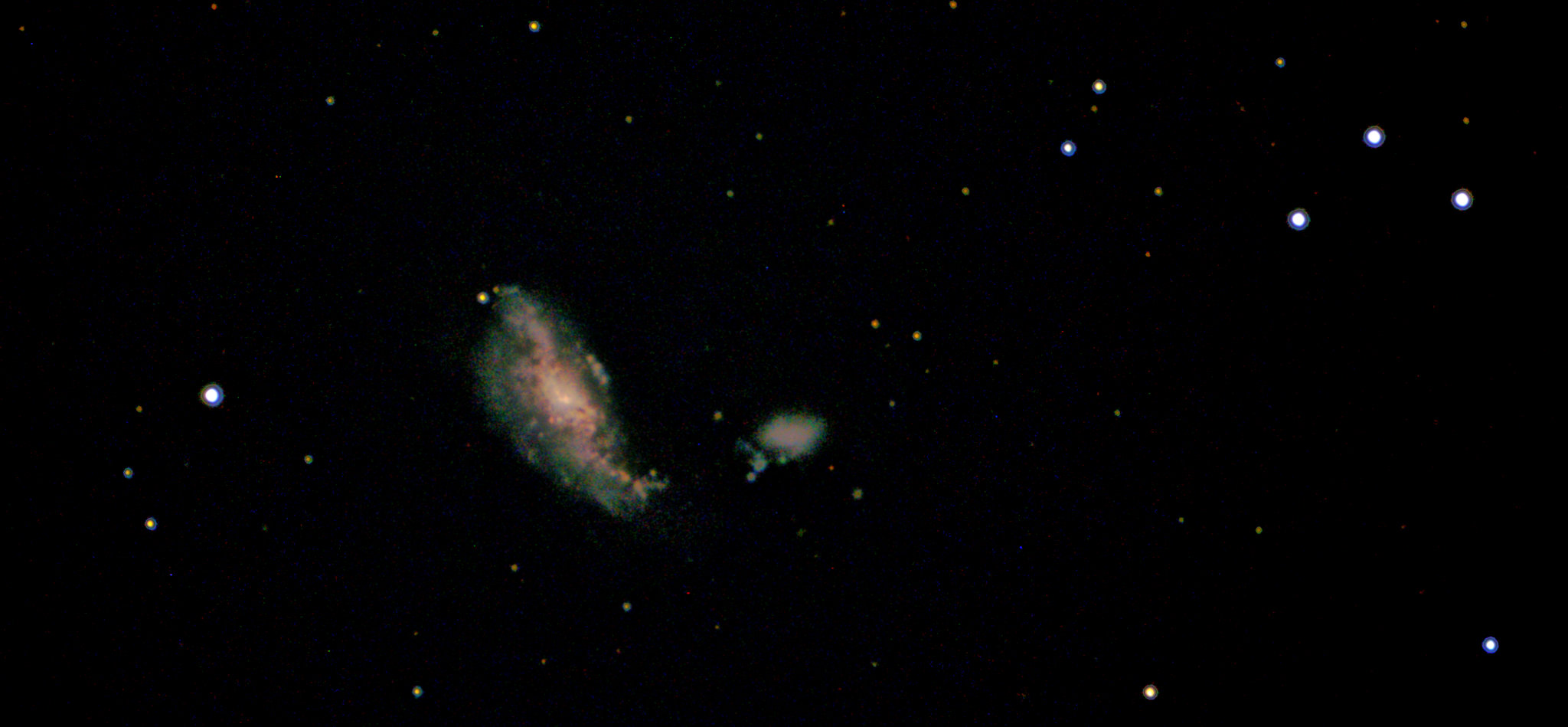
Arp 90 / NGC 5930 and 5929 | Spiral galaxies with large high surface brightness companions on arms | 2025-07-22 00:20:00 | Arp categorizes this galaxy "doublet" as, "Spiral galaxies with large high surface brightness companions on arms". In this case, NGC 5930 (left) is the "spiral galaxy" and 5929 (right) is the bright companion. Arp's recorded remarks include this notation: "Absorption lanes around companion." I interpret this to mean the dark "arm" (in the inverted images) extending down from the top and along the right quarter of 5930's nucleus and effectively surrounding 5929's nucleus. Arp is suggesting that matter is being exchanged between the two of them. Obviously, some sort of strong interaction is taking place. Whether a merger is the ultimate result, or 5929 will emerge as an independent galaxy is unclear. |
 |
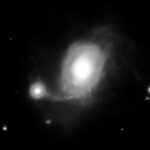
Arp 91 / NGC 5953/5954 | Spiral galaxies with large high surface brightness companions on arms | 2024-05-23 22:27:00 | NGC 5954 and 5953 are pretty small, but bright enough to capture even during a nearly full moon (luckily pointing to a very different part of the sky). They appear to be merging (or at least strongly interacting during a "fly by"). NGC 5954 (left) is an elongated spiral, though it's unclear to me whether the elongation was caused by this interaction or an earlier one. I suspect the latter since the distortion isn't obviously in the direction of its current partner. NGC 5953 (right) is a nearly featureless elliptical galaxy. Arp's remarks, "Broad pec. arm to comp., then absorption: faint extension from comp," accurately describes the connection and suggests they saw one companion. I debated whether there might be two, dwarf galaxies interacting with the primary pair. Both bright objects (SW, lower right, NW, upper right), I continue to interpret as field stars distorted by poor seeing rather than galaxies. |
 |
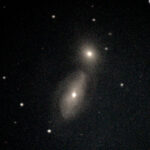
Arp 92 / NGC 7603 | Spiral galaxies with elliptical companions on arms | 2025-11-22 18:40:00 | This target was captured on a dark night, with only so-so seeing. I was hoping to capture the target with both quasars visible. In the event, my captures only hint at them (In fairness, Arp's original only hinted at them).. This galaxy is one which Arp chose to present in a 2004 documentary. There he discusses the issues discovered by two young, Spanish astronomers who observed the target in 2001 and whose final results were published in a respected, European, peer-reviewed journal in 2004. |
 |
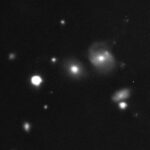
Arp 94 / NGC 3227 | Spiral galaxies with elliptical companions on arms | 2024-03-26 18:15:36 | Last observation on a full moon night before high clouds and reflected moonlight killed observing. Arp 94 appears to show two galaxies in close proximity. NGC 3227 is the much larger, spiral partner that has been greatly elongated by the encounter. Obviously, we can't tell why it's so elongated, but I presume the ellliptical galaxy, NGC 3226 may have nearly escaped, and shed many of its stars while passing, creating the elongated appearance. The exchange of stars is evident in the extensive dust cloud connecting the two galaxies, best viewed in the inverted image. |
 |
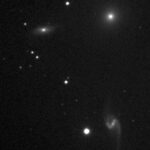
Arp 95 (Galaxy Cluster) | Spiral galaxies with elliptical companions on arms | 2025-07-30 23:20:00 | The two members of Arp 95 are IC 4462, a SBb starburst galaxy, and PGC 52123 an elliptical galaxy next to it. Arp notes: "Star-like condensation in spiral." (presumably the black dot to the right of the nucleus. Also: "Connection to E galaxy inferred, not seen". I don't see any sign of connection either. IC 4461 is at a higher redshift, and presumably, therefore, would not support direct interactions. |
 |
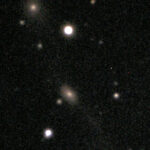
Arp 99 / NGC 7547, 7549, 7550 | Spiral galaxies with elliptical companions on arms | 2024-10-27 20:50:00 | This is a fascinating cluster which appears to capture 3 galaxies in a dance of attraction. The elliptical galaxy NGC 7550 on the top, center (south) appears to be dominating. It seems to have unwound the spiral galaxy NGC 7549 (bottom center) into an extended S curve, and to be attracting and stretching the more intact spiral galaxy NGC 7547 (probably a circular spiral at first). That said, I inverted the image to see if I could see any dust lanes indicating exchange of mass. Pushing on stretching the inverted image as hard as I dared (see gallery), I believe there's a hint of a connection between 7547 and 7550, and likely none with 7549.. I also wonder whether NGC 7553 participates in this dance as well (and possibly 7558). They're not included in the Atlas, but I wondered if they might have been outside the FOV of the Hale Telescope, and therefore not considered. So I investigated. According to the CalTech website, image scale at 1x (lowest) magnification on the Hale Telescope was 11.1" per mm. Plates were usually 5 inches x 7 inches, converting to 178 mm, or 0.55°/33". Turns out that the angular distance from NGC 7547 (western most) to NGC 7558 (easternmost) is under 10", so the FOV was not a limiting factor. |
 |
Arp 101 / UGC 10164-10169 | Spiral galaxies with elliptical companions on arms | 2024-06-13 23:07:00 | The Uppsala General Catalogue of Galaxies (UGC) lists 12,921 galaxies visible from the northern hemisphere, first published in 1973. The fact that the two key galaxies in Arp 101 are listed in UGC (and not NGC or IC) underlines how obscure they are. Neither is in Astrometry.net's annotation system. We flipped our image 90° clockwise to match the orientation in Arp's catalog, which means south is up. The more southerly galaxy UGC 10164 (upper) is the "eliptical" galaxy referred to in Arp's categorization at magnitude 14.7; its spiral companion UGC 10169 is 14.9 (the spiral structure is barely evident in my capture color capture and more in my grayscale, inverted image as well as in Arps'. The critical features are the bridge between the two galaxies and the extended tail on the spiral 10169, which are substantially fainter yet. Suggesting that the bridge between the two galaxies represents a companion "on the arm" of 10169 seems a bit of a stretch (pun intended). During the capture in SharpCap my emphasis was on showing these connections and not worrying about the background noise or darkness. I wasn't sure if I'd be successful in capturing them, especially given there was a 50% illuminated moon during the capture. I was pleased with the result. I had to cut this observation short due to high clouds starting to trigger the brightness and FWHM filters in SharpCap. |
 |
Arp 103 | Zwicky’s Triplet | Elliptical galaxies connected to spiral galaxies | 2025-07-02 23:07:00 | Arp credits Zwicky in Table 1 of the Atlas as the source for this object. It consists of 3 galaxies: the brightest (magnitude 15) is PGC 59061 (bottom left). Overlapping it is PGC 59062 (bottom right). Two arcminutes to the north is PGC 59065, a lenticular galaxy of magnitude 16. Key to its "peculiarity" is a faintly luminous tidal arm connecting PGC 59061 and PGC 59065. Arp notes in his remarks to the Atlas: "Incomplete connection, blue knots in southern member." |
 |
Arp 104 / Keenans System | Elliptical galaxies connected to spiral galaxies | 2024-02-21 01:00:44 | This was the last observation of a very clear night, marred only by a 94% moon. I chose Arp 104 in part because I could point in the opposite direction. The key feature here is the dust lane connecting the two galaxies. Luckily it became evident after about half an hour and I was able to continue observing for a total of 60m. The featured image here was enhanced in Affinity Photo to accentuate the dust. A "natural" colored image is in the gallery. |